
The Value of a Passport: Navigating the Golden Passport Landscape
In today’s globalized world, not all passports carry the same weight. While the color may be similar, the ability of a passport to facilitate international travel and access to various opportunities differs significantly. Every year, organizations like Henley & Partners rank passports based on the number of countries their holders can freely enter. Beyond traditional avenues of citizenship, such as birthright or naturalization, there exists a more direct route for acquiring a passport: purchasing one through citizenship-by-investment programs.
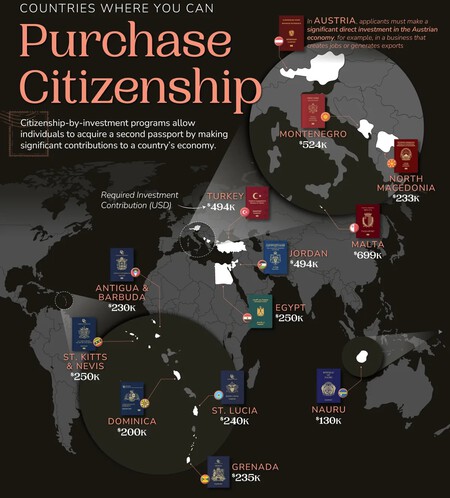
Citizenship by Investment: Where and How
Citizenship by investment allows potential passport holders to acquire nationality in exchange for a financial contribution to the country. According to a recent Visual Capitalist report, 13 countries offer this unique opportunity. Among them, Malta stands out as one of the most sought-after, providing access to 184 countries . However, its program will become unavailable in 2025, leading to an increased demand.
Additionally, both Montenegro and North Macedonia offer their own respective citizenship programs, with access to 127 and 128 countries, respectively. Despite the opportunity for passport acquisition, the cost of these programs can be high.
Investment Requirements: Financial Insights
| Country | Investment Required |
|---|---|
| Malta (not available from 2025) | $698,580 |
| Montenegro | $524,000 |
| Jordan | $493,640 |
| Türkiye | $400,000 |
| Saint Kitts and Nevis | $250,000 |
| Egypt | $250,000 |
| Saint Lucia | $240,000 |
| Grenada | $232,860 |
| North Macedonia | $232,860 |
| Antigua and Barbuda | $230,000 |
| Dominica | $200,000 |
| Nauru | $130,000 |
Monetary Motivation: Understanding the Investment
Many of the Caribbean countries have established citizenship programs that offer similar price points, leading to the question: where does the money go? In essence, these payments are contributions made to the government for economic development, social programs, and the enhancement of infrastructure. For instance, obtaining a passport from Saint Kitts and Nevis involves financial contributions to the Sustainable Growth Fund or a significant real estate investment.
The allure of these passports is rooted in the ease of acquisition. In Caribbean nations, there’s no need to pass language exams or reside in the country. Instead, individuals can receive their passports within a few months after making the requisite payment.
Challenges and Regulation: Are These Programs Ethical?
Critics question whether citizenship-by-investment programs adhere to ethical standards. The European Union has expressed concerns regarding these practices. Malta was once a frontrunner in citizenship-by-investment, but in April 2025, the European Court of Justice ruled that such programs violate EU law, particularly the principles of cooperation among Member States. As a result, Malta halted its program while Cyprus and Bulgaria have also ceased similar initiatives.
Despite the regulations, countries such as North Macedonia continue to allow pathways for citizenship, although the application process remains opaque. All applicants must undergo thorough background checks to verify the source of their funds and their personal histories, ensuring they are not involved in illegal activities.
Expanding Global Mobility: The Lasting Appeal of Golden Passports
The concept of the Golden Passport persists in many countries as a pathway to enhance global mobility. Austria, for instance, extends citizenship to foreigners exhibiting “extraordinary and significant merits,” while Canada offers the Quebec Immigrant Investor Program requiring substantial financial contributions alongside personal qualifications. Meanwhile, the EB-5 program in the United States necessitates nearly a $2 million investment but leads to a green card rather than citizenship.
In conclusion, the Golden Passport landscape remains convoluted, shaped by geopolitical dynamics, economic constraints, and ethical considerations. As these programs evolve, the doors they open for those willing to make substantial financial commitments will be closely monitored by both governments and citizens alike.