
Just a couple of days ago, we learned about China’s new rare earth regulations , which completely disrupted the global map of strategic minerals. Considering that the Asian giant supplies approximately 70% of strategic minerals to the world, it could be said that China is the global mine of an essential raw material for the technology industry. This gives it a privileged position to apply a standard of this caliber: any product manufactured outside of China with at least 0.1% of materials of Chinese origin will require a license for export .
This means that China not only controls what leaves its territory but also what other countries produce using its materials and technologies. The new policy enables China to decide what is exported, to whom, and for what purpose—all under national security criteria. After a few hours of digesting the news and speculating about a potential response from Donald Trump , and even his non-attendance at the next event where he will meet Chinese President Xi Jinping , the United States announced unprecedented 100% tariffs .
New Tariffs, More Control, and a Date That Invites Negotiation
The President of the United States has exploded on Truth Social, referring to the new regulations as “an extraordinarily aggressive stance on commercial matters,” and calling it “an extremely hostile letter” from China. He further emphasized the situation by stating that this policy is a “moral shame in dealing with other nations,” indicating that it affects not just the products they manufacture but also those they do not. Trump has asserted that “It was evidently a plan drawn up by them years ago.”
In a shocking move, Trump announced on Truth Social that the United States will impose a new 100% tariff on China, which will be added to any other tariffs already in place. Importantly, this new tariff also includes export controls on all critical software . It’s noteworthy that nearly all products imported from China into the United States are already subject to high tariffs, ranging from 50% on steel and aluminum to only 7.5% on consumer goods , resulting in an effective tariff rate of around 40% , according to analysts from Wells Fargo Economics and the Federal Reserve Bank of New York .
Furthermore, Trump has left an important date for these measures to take effect: November 1, 2025 .

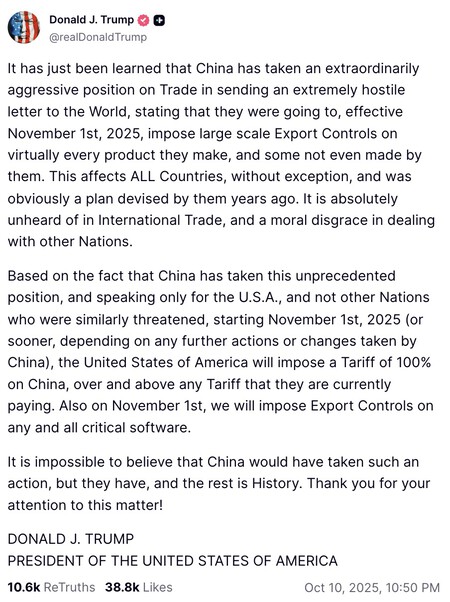
</div>Looking between the lines, the date chosen by Trump is no coincidence. It aligns perfectly with China’s timelines concerning the implementation of its rare earth measures. His message hints at a predisposition for negotiation , noting the threshold of November 1, 2025 (or sooner, depending on actions or changes China takes) . Trump emphasizes that he speaks on behalf of the United States, not “from other countries equally threatened.” This may serve as a rallying call for potential allies as the geopolitical landscape continues to evolve.
This moment also brings into focus the historical background of both nations regarding rare earths. The complex relationship started around 1978, when Chinese engineers visited key U.S. companies. Shortly thereafter, a vast empire of rare earth mining and production was established, making China a critical player in this lucrative industry. As of today, China’s position in the global technology supply chain is unassailable, and the implications of its new regulations will resonate across various sectors.