
Astronauts who have been fortunate enough to travel to space more than once in the last decade are privileged witnesses of a chromatic change on a planetary scale. From their vantage point 400 kilometers high, they have been able to see that the cities, previously faint spots of amber, now shine with an intense white light .
It’s not a metaphor. This change represents the visible trace of one of the most rapid and widespread infrastructure transformations in recent history: the great replacement of public lighting . We have retired the old sodium vapor streetlights and massively embraced LED technology. This change, driven by regulations in favor of energy efficiency , has redrawn the night map of the Earth, a phenomenon that can be seen more clearly from space.
The invention that earned a Nobel Prize in Physics. Old sodium vapor lamps, especially low-pressure ones, were monochromatic in nature. They emitted light in a very narrow band of the spectrum, resulting in that characteristic and ubiquitous yellow-orange hue that tinted our streets and skies. On the contrary, LED lights work in a completely different way.
The breakthrough that earned Isamu Akasaki, Hiroshi Amano, and Shuji Nakamura the 2014 Nobel Prize in Physics was the invention of the high-efficiency blue LED . By combining this blue LED with a phosphor coating, it became possible to generate a bright and affordable white light. This diode is not only more efficient, exceeding 300 lumens per watt , compared to only 16 for an incandescent bulb , but it also offers a much broader spectrum of light.

Southern Europe in 2025 from the International Space Station. Image: Don Pettit
The cities changed color. To the eyes of a night observer in space, cities have transitioned from yellow to a glowing bluish white . Milan serves as a paradigmatic case: it completed its transition to LED in 2015 and appears in an ESA comparison with before-and-after photos taken by astronauts André Kuipers and Samantha Cristoforetti. However, it is by no means the only case.
Los Angeles was a pioneering city, having ordered the replacement of 140,000 streetlights back in 2009. Buenos Aires modernized its lighting with smart LED streetlights between 2013 and 2016. New York finished replacing 500,000 bulbs in 2023. Barcelona plans to achieve total remote management of public lighting by 2028. Interestingly, India has the largest replacement program in the world, with over 13 million LED streetlights already installed.
The B-side of this transformation. Like every revolution, the LED revolution has a dark side . Light is cheaper, so cities are not only replacing old streetlights but also increasing the number of light points or their intensity. As a result, we find ourselves with a brighter planet , making it more challenging to escape from light pollution .
Statistics may suggest otherwise, but it’s crucial to understand that light pollution is measured by satellites, which are partially blind to blue light. Consequently, the actual increase in light pollution, especially that which is perceived by human beings, is much higher than official figures indicate. Furthermore, blue light significantly interferes with our biological clock , affecting sleep quality and disorienting migratory birds and moths.
The future is adjustable. The solution does not lie in reverting to sodium. The efficiency of LEDs is indisputable. The key, as with any technology, is in its application . The next phase of this transition is not about merely swapping out bulbs but installing smart streetlights . It is estimated that nearly one in four streetlights will be smart by 2030. When connected, they can regulate their lumen intensity based on factors such as time of day or traffic conditions, detect failures in real time, and even collect environmental data .
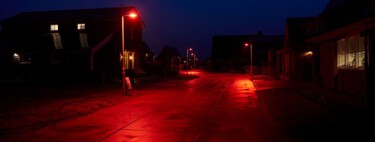
This remote management will allow one of the new lighting principles to be enacted: using only the necessary light when and where it is needed. Concurrently, innovative solutions have emerged to protect biodiversity, such as streetlights with red light , which are currently being tested in Nordic cities to avoid disturbing mammals like bats. Furthermore, ideas surrounding bioluminescence as an organic source of light generation continue to gain traction, promising minimal environmental impact without any electricity consumption.