

The Shifting Landscape of European Energy
The European energy map is evolving at a pace that few would have anticipated only three years ago. The traditional gas pipelines connecting Siberia to the industrial core of the EU are being sidelined, with new routes and alliances reshaping the energy power dynamics across the continent. Although Europe asserts its intent to isolate Moscow, an exception exists within its borders that could alter the intended narrative, potentially shifting the balance of power in the upcoming winters.
A Map in Transformation. Yes, the European gas landscape has undergone a radical transformation in recent years, leading to an unprecedented situation in the winter of 2025—the first in decades where Russian gas is no longer a decisive factor throughout the European Union. Following the invasion of Ukraine in 2022 and the ensuing energy crisis from 2021 to 2023, Brussels urgently called for supply diversification . This pivot relied heavily on liquefied natural gas (LNG) imports, particularly from the United States and Qatar , while counting on Norway as a dependable partner.
The grand pipelines that traditionally carried gas from the Siberian fields to Europe have either been damaged or reduced to a secondary role. With energy security increasingly dependent on the global LNG market , European infrastructures are now vulnerable to cyber attacks and other hybrid threats. In this evolving context, every molecule of gas carries varying degrees of significance, with some crucial to defining Europe’s independence more than others.
The Two Exceptions. Despite the EU’s commitment to weaning itself off Russian energy, two nations— Hungary and Slovakia —continue to maintain their imports from Moscow. In August 2025, these countries collectively imported Russian crude oil and gas worth over 690 million euros , a significant proportion of the European total. They persist in receiving supplies via the mammoth *Druzhba* pipeline, which traverses Ukraine and Belarus, using a temporary exception granted by Brussels for landlocked countries to legitimize their dependence.
While nations such as France, the Netherlands, and Belgium have refrained from purchasing significant amounts of Russian LNG, Budapest and Bratislava continue to import crude oil and gas directly from Moscow, keeping alive an energy artery that the rest of Europe seeks to close.
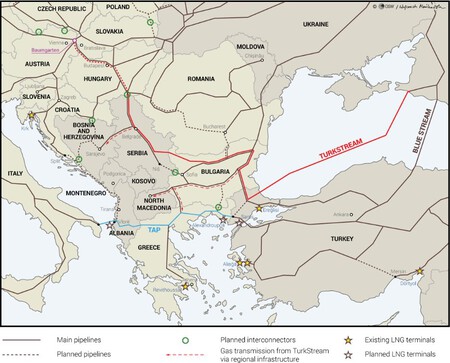
Hungary and Slovakia are investing in gas infrastructure, creating a gas block in the heart of Europe aimed at protecting against risks.
The Role of the USA, Brussels, and Intense Pressure. The inflexibility of Viktor Orbán and Robert Fico has caught international attention. At the UN, Trump accused Europe of “financing the war against itself,” directly naming the Central European countries doing business with the Kremlin. Meanwhile, Brussels has been intensifying pressure for greater compliance, debating potential sanctions that might restrict imports from Russia in categories including LNG.
Although discussions have emerged regarding a ban on Russian LNG by 2026 and further penalties against giants like Rosneft and Gazprom Neft , Brussels hesitates to enact immediate pipeline restrictions, fearing a backlash from Budapest and Bratislava. Nevertheless, the EU Commission is poised to introduce specific tariffs against remaining Russian imports and has called for Member States to submit plans for disconnection by 2027, a year expected to mark the final break.
The Discourse of Dependency. Hungary insists its economy would suffer a 4% contraction immediately if Russian gas supplies were to cease. Both leaders have labeled any attempt to end these flows as “economic suicide.” However, experts dismantle many of these arguments, emphasizing that geography should not act as an excuse in an integrated market where other landlocked countries like Austria or the Czech Republic have significantly curtailed their Russian imports.
Alternative infrastructures exist, including the Adria pipeline , which connects to the Adriatic Sea, potentially providing significant crude oil supplies to Hungary and Slovakia. The Croatian company JANAF asserts it can service both Hungarian and Slovak refineries. Additionally, interconnections with neighboring countries and an expected boom in LNG availability post-2026 suggest that ceasing Russian imports would be more of a political challenge than a technical one.
Political Underpinnings and Benefits. Budapest’s steadfastness also has internal political and economic ramifications. The MOL oil company—aligned with the Orbán government—has profited immensely from the price disparity between Russian Urals crude and Brent , generating significant revenue. Orbán’s government ties the continuity of Russian supply to the stability of its energy subsidies, despite the fact that prices reflect broader international trends.
In Slovakia, Fico safeguards existing contracts with Gazprom, although national company SPP maintains flexible agreements to ensure supply without leaning on Moscow.
A New Axis in the Black Sea. Notably, Hungary and Slovakia are not just resisting the termination of old Russian gas pipelines but are actively pursuing new connections. The route that links through the TurkStream and enters Central Europe from Turkey consolidates a direct line to Moscow, contradicting Brussels’ isolation efforts.
These two Central European nations are positioned as a crucial Russian corridor into the EU, fundamentally opposing the strategy for energy autonomy while simultaneously reinforcing reliance on an adversary deemed hostile.
Europe’s Internal Contradiction. The dilemma is evident as the European Union publicly declares its intent to eliminate Russian imports in two years. Simultaneously, it tolerates exceptions that inadvertently fortify the Kremlin’s position and offer Putin renewed hope for reestablishing his importance in the European market. Hungary and Slovakia present vulnerabilities within Europe’s strategy, arguing that cutting off Russian gas would harm Europe more than Russia itself.
The reality suggests available technical alternatives and underscores the political dimensions behind their reluctance to act. Ironically, their actions in securing energy supplies are constructing an energy bridge that links the EU with Russia at a time when the continent publicly aims for isolation.