

The Emergence of Online Gaming: A Glimpse into 1990
We live in a highly connected world in which the Internet is present on our computers, mobile phones, consoles, and even refrigerators. Never in history has it been so easy to access information, play online, or control devices from a distance. However, as we all know, this has not always been the case.
The year is 1990. It may be a little surprising to think that in 1990 Japan not only was already connecting to the Internet, but some people were connecting modems to their video game consoles to play online. And the most curious thing about this service is that the country was not even among those that had the most developed connectivity offer.
The data. To give a little context, according to Worldmapper data, about 3 million people had access to the Internet in the inaugural year of the 1990s. Most of the users were distributed between the United States and Europe. In the connectivity ranking, Japan was far behind, outside the top 10 positions.
Pioneers. However, the Japanese company Sega did not hesitate to embrace the network of networks with its Mega Drive console (known as the Sega Genesis in other markets). It was its fourth-generation 16-bit console that had been launched in 1988 and had already gained immense popularity.
The device was powered by a 7.6 MHz Motorola 68000 microprocessor to run the games and had a Zilog Z80 coprocessor. Gamers enjoyed enhanced experiences with 64 KB of RAM, 64 KB of VRAM, and 8 KB of audio RAM.
Two years after its launch, specifically on November 3, 1990, Sega launched the Mega Modem in Japan. This groundbreaking accessory connected to a DE-9 port located at the back of the console, enabling it to go online.

Dial-up. As you can surely imagine, the offering of online services back then was very primitive. Nonetheless, Sega encouraged players to enjoy online gaming and to download games via dial-up connections.
Using a telephone connection with speeds around 1200 bauds (1.2 Kbps), users had to store all downloaded games in the Mega Drive’s memory, given there was no additional storage device.
Variety of games. At that time, Sega provided two options to access the Mega Modem. Players could either purchase the accessory along with a game cartridge for 12,800 yen, granting access to various titles, or buy the Mega Modem separately for 9,800 yen with the requirement to purchase compatible games separately.
Included titles featured a diverse lineup: ‘Nikkan Sports Professional Baseball VAN’, ‘Cyberball’, ‘Advanced Grand Strategy’, ‘TEL/TEL Stadium’, ‘Forbidden City’, and ‘TEL/TEL Majan,’ the latter offering mahjong gameplay with options for both single-player and online play.
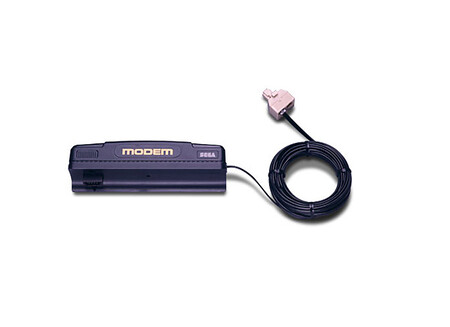
Mega Modem
Purchasing separately. Users also had the option to buy the Mega Modem separately for 9,800 yen, while understanding they would need to purchase compatible cartridges individually to utilize the modem.
One of the most successful cartridges was called Sansan, a Go strategy game allowing players to compete online. The developer, White Box, created a platform where users could play with others via the Mega Modem using their unique Sansan ID. Although this innovative offering was intriguing, it ultimately did not resonate with the market, leading Sega to discontinue it by the end of 1992. Following this, new Mega Drive versions launched without the modem port, marking the end of Sega’s initial foray into online gaming.
Reflecting on the innovations introduced by Sega, we can see how the attempts to expand online gaming offerings paved the way for the modern gaming landscape we enjoy today. Despite its short lifespan, the Mega Modem was a significant step in the evolution of video game connectivity, and it serves as a reminder of the increasing importance of online features in our gaming experiences.