

Exactly 40 years ago, HP packed up its original facilities in Terrassa (Barcelona) and moved to land on the outskirts of Sant Cugat del Vallés (Barcelona) to expand facilities that the success of its printers left too small. We have visited those same HP facilities in Spain, and although the machines that manufactured printers have been turned off a long time ago, we have discovered the equivalent of a small Silicon Valley in Spain from which you can imagine what the technological future will be like .
From Growing Cereals to Generating Ideas
The center located in Sant Cugat del Vallés celebrates 40 years since, in 1985, the company moved its facilities, taking with them the 30 employees that made up its staff at that time.
In those years, the facility was designed as a production center for its printers. However, in 2000, production was relocated to Asia . Given the new situation, the center was on the brink of closure. The Sant Cugat facilities, which at that time already had more than 800 employees , of which 200 were engineers, were reinvented, transforming the center into a factory of ideas and a laboratory of innovations that has not stopped growing in its four decades of existence.
Currently, the complex is distributed across 11 buildings that house 2,600 employees of 60 nationalities . 800 engineers work side by side with other companies to develop new practical solutions for their businesses. “In 1985, there were farms here, and now this space has become the Silicon Valley of the city,” Helena Herrero, HP president of Southern Europe, the Middle East, and Africa, told us proudly. No wonder; she was part of that team that put these facilities on the innovation map, turning it into one of the two largest HP R&D centers in Europe and the world comparable to that of HP’s headquarters in Palo Alto.
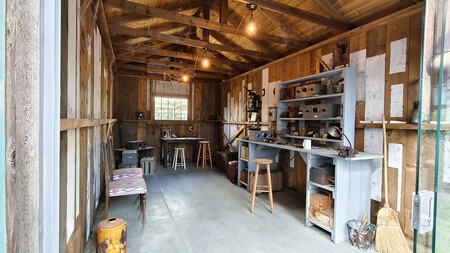
Recreation in Barcelona of the Hewlett Packard garage in Palo Alto
We were greeted by a symbolic testament to that spirit of innovation: a detailed recreation of the famous garage where Hewlett and Packard created HP 85 years ago in Palo Alto. In that garage, not only was Hewlett Packard born as a company, but it served as inspiration for the creation of that ecosystem of companies that we know today as Silicon Valley .
As happened in Silicon Valley, around the recreation of that garage, HP has created a center for innovation and development of new ideas and products that will be decisive for the future in areas as diverse as Formula 1 , prosthetic medicine , culture, construction, or work efficiency. This center registers more than 150 patents a year for HP .
Ideas That Have Come True and We Have Been Able to See and Touch
One of the peculiarities of this HP center is that companies come asking for help to solve a problem, and the HP teams work with them to find innovative solutions. The most recent example is the collaboration of these engineers with the Ferrari Formula 1 team. In this case, the challenge was to lighten the weight of the car as much as possible without compromising the aerodynamic sliding of its body.

Daniel Martínez, head of the large format printing division and director of the center, shared that the Sant Cugat engineering team developed a latex printing technology that was then applied to the vehicle body like vinyl. This sheet reduced its weight by 17% compared to conventional paint without compromising aerodynamics.
In our visit to this HP ideas laboratory, we saw that engineers are developing solutions in other, much more futuristic areas in which robotics and printing go hand in hand.
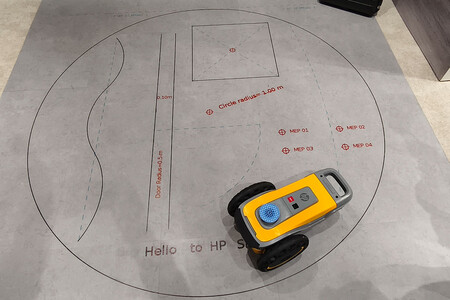
It looks like a Roomba, but it actually draws plans
An idea born within these walls has given rise to the SitePrint project, a hybrid between a printer and a robot vacuum cleaner that prints on the ground the dimensions of the plans of work. The combination of a complex system of positioning and inclination sensors allows the robot to establish its position in space and detect unevenness in the ground, providing additional information to the construction team to level the ground.
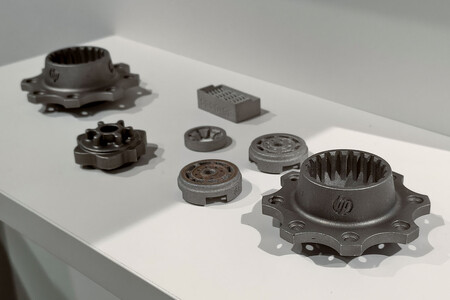
3D printed metal parts
Another application developed in this avant-garde center in Barcelona involves the evolution of 3D printing with new techniques and materials utilizing Metal Jet technology . Among its novelties, the use of generative AI simplifies the design of the parts to be printed or develops systems with metals to manufacture high-precision mechanical parts and components. One fascinating aspect of this technology is the ability to mix flexible materials with a rubber-like texture with rigid areas that exhibit metal hardness. This opens a broad range of possibilities for prosthetics and casting replacements using 3D printing.
New Turn Towards the Future: AI
As a symbol of the innovative spirit and reinvention of this center in Sant Cugat, HP has rehabilitated a 15th-century farmhouse that was in a state of semi-ruin on the land occupied by the enormous HP technology campus. This has been transformed into La Masia Experience Design Center , the spiritual heart of its new growth stage, including the creation of the HP AI Innovation Hub .
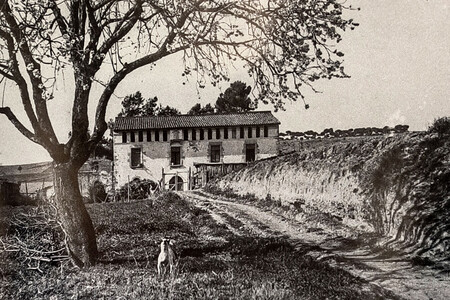
The Masia in its original state. Source: HP
With this new hub focused on AI, the Barcelona facilities become the reference center in Europe for the development of AI LMM models that HP will leverage in future products, including local AI agents and video conferencing assistance systems, marking a significant technological stride. The AI hub will collaborate across 14 business units of the company, enhancing synergies with all the development centers worldwide, especially the headquarters in Palo Alto, where there is also a specialized AI team.
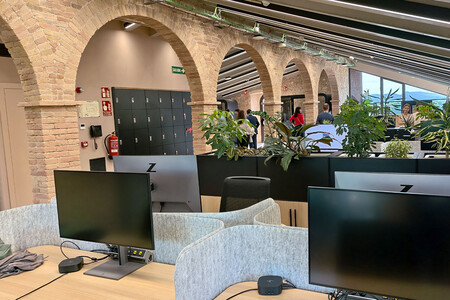
Interior of La Masia Experience Design Center after its reconstruction
The Sant Cugat HP center will undergo another transformation, bringing together a team of 200 engineers dedicated solely to AI development, mirroring its past growth phases in 1985 and 2000. Helena Herrero highlighted that although specific data on the workforce growth was not disclosed, current employees are being reskilled toward artificial intelligence competencies.
“The center is a school of global talent, where many professionals started in Sant Cugat and now occupy key positions in the company, including Enrique Lores , HP’s current global CEO, who began as an intern here,” noted Inés Bermejo, general director of HP Iberia. The center collaborates with various universities in Barcelona to train and attract the best local technological talent.
According to Daniel Martínez, this new team will closely cooperate with leading AI players (OpenAI, NVIDIA, etc.) to develop cutting-edge products and integrate them into new tools for its clients. “We are at that inflection point to take that momentum for the future,” Herrero commented. This ongoing commitment to innovation positions HP at the forefront of technological evolution.