
Marcos Llorente: The Footballer with a Unique Approach to Health
Marcos Llorente is making headlines once again, but this time it has little to do with football. Instead, it revolves around a video published by the RFEF during the national team’s training camp. In the nearly four-minute clip, the Spanish footballer reveals some of his unorthodox health routines . His practices include using red light therapy at home and wearing yellow-tinted glasses to block out blue light.
The release of this video stirred a range of opinions, causing experts to raise their eyebrows at Llorente’s eccentric remarks regarding personal well-being. His statements have propelled him into the spotlight beyond the realm of sports as he discusses the implications of light on health.
What Did Marcos Llorente Share?
Llorente’s video details his everyday interactions with light sources . According to him, he rarely turns on artificial lights during the day. “I’m either outside in the garden or I let natural light flow in through the windows,” he explains. “At night, I use this special lamp that emulates red and infrared light similar to what’s found outdoors.”
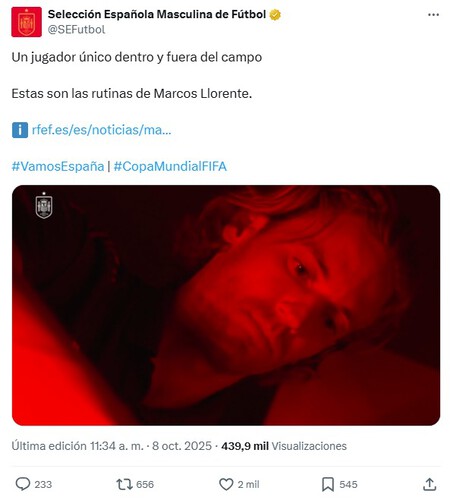
Click on the image to go to the tweet.
The Use of Yellow Lenses
In the same video, Llorente discusses another accessory that has caught public attention: yellow-lens glasses . “I wear them indoors throughout the day. However, when I step outside, it’s essential to let natural sunlight hit my skin and eyes without any interference,” he states, emphasizing that blue light exposure from screens can be mitigated with these glasses. “Red-tinted glasses can filter out the blue light emitted from artificial sources like lamps and screens.”
Health Benefits Discussed by Llorente
For Llorente, these practices are less about improving his performance on the football field and more about overall health improvement . “These habits enhance my well-being, not just my game,” he asserts. “When I eventually retire from football, I plan to continue with these health practices and even improve them.”
Expert Opinions on Light Filters
However, Llorente’s claims have prompted skepticism among health professionals. The effectiveness of blue light filters remains highly controversial . The Spanish Society of Ophthalmology previously noted that “blue light from screens does not negatively affect vision or cause blindness.” They emphasize that natural sunlight is the largest source of blue light exposure.
Dr. Rahul Kurana, a spokesperson for the American Academy of Ophthalmology, has echoed similar sentiments, affirming that the blue light from digital devices is far less than what we receive from the sun. “Moreover, this exposure is no more harmful than the light from the sun,” he comments.
According to ophthalmologist Sara E. Hernández, there is minimal to no visible improvement in vision performance with the use of yellow-tinted lenses. In her statements to *The Vanguard*, she notes, “Studies show no significant differences in visual acuity or depth perception when comparing conventional lenses to those with a blue light filter.”
Growing Concerns About Blue Light
The growing concern around blue light exposure isn’t new, particularly as screens and LED technology have become prevalent in daily life. Users, academics , and health professionals alike have debated the potential risks associated with blue light exposure. Many—including the American Academy of Ophthalmology—have published articles debunking common myths around blue light’s supposed dangers, including a statement by Dr. Khurana which says, “There is no scientific evidence suggesting that blue light emitted from electronic devices causes harm to the eyes.”
Marcos Llorente: A Figure of Controversy
While Llorente’s recent claims have stirred up conversations on health and wellbeing, this is not the first time he has made headlines for his out-of-the-box opinions. Considered a controversial figure for his views on various topics, his significant status as a professional footballer amplifies his reach and influence. As a result, his remarks often provoke significant public interest.
The video shared by the RFEF further solidifies Marcos Llorente’s role as a character who blurs the lines between athlete and lifestyle influencer, shifting discussions on health into the sports arena.