
Renewable Energy Surpasses Coal: A Turning Point for Global Energy
Ten years ago , coal was the backbone of power generation, illuminating half the planet. Today, that narrative has shifted dramatically, with solar panels and wind turbines leading the charge in global energy production. According to a report by Ember , in the first half of 2025, renewable energy sources not only met the growing demand for electricity but also exceeded it, marking a significant moment in energy history.
A global sorpasso. The Ember report analyzes data from 88 countries , representing 93% of global electric demand. This historic finding highlights how solar and wind energy have surged to a level where they now make up a significant portion of the electrical mix, surpassing coal for the first time. In this shifting landscape, coal generation has declined , with carbon participation dropping to 33.1% and renewables rising to 34.3% . This transition is particularly notable in regions traditionally dominated by coal, such as China and India .
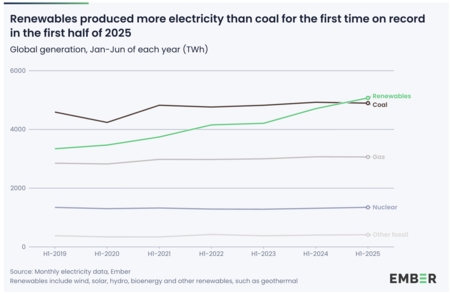
<span>Renewable energies produced more electricity than coal for the first time recorded in the first half of 2025 | Ember</span>Radiography of the change. The transition from coal to renewable energy is not just a fleeting trend; it signifies a structural transformation in global electrical consumption. In the first half of 2025, worldwide demand rose by 369 TWh (an increase of 2.6% ), with solar and wind energy fulfilling this demand, thereby establishing themselves as the go-to sources of electrical generation.
Solar energy remains the most dynamic force in the renewable sector, showing a 31% growth rate and now accounting for 8.8% of global electricity generation. China played a pivotal role in this surge, contributing 55% of global solar growth. The United States , European Union , and India are also significant players in this renewable energy renaissance.
Wind energy also kept pace with a 7.7% increase, representing 9.2% of the global energy mix. While Europe and the United States were impacted by adverse weather conditions, China’s wind production surged by 16% , showcasing its dedication to renewable energy.
The money also changed sides. Financial investment serves as another indicator of this transformative energy landscape. The International Energy Agency projects global energy investments will reach $3.3 trillion by 2025, up from much lower figures just a decade ago. Renewables, previously viewed as an idealistic endeavor reliant on government subsidies, have now become the focal point of global energy finance. The ratio of clean investments to fossil fuel investments dramatically shifted from 2:1 in 2015 to an unprecedented 10:1 in 2024 .
Despite these positive trends, challenges remain. Emerging markets and developing economies receive a mere 15% of global investments in clean energy, even though they are witnessing the most rapid growth in electric demands. High financial costs , fragile infrastructure, and regulatory uncertainty continue to stymie progress in these regions. Ember emphasizes that without international financing and technological cooperation, efforts to reach zero net emissions could stall.
<img alt="Europe is turning the North Sea into a gigantic wind turbine field. The objective: produce green hydrogen" width="375" height="142" src="https://i.blogs.es/de27cc/guia-de-imagenes-destacadas-1-/375_142.png"/>China drives the global transition. As the world experiences this paradigm shift, China emerges as the leading force in renewable energy production and technology. The country not only leads the production of clean energy but also dominates the industries necessary for its creation—solar panels, wind turbines, batteries, and smart grids. China’s proactive industrial policies have positioned it as an “electrostate,” giving it a competitive edge in the energy value chains of the 21st century.
During just six months, China managed to install an astonishing 380 GW of new solar capacity, surpassing the total solar capacity of the United States. This growth is pushing China’s electricity generation towards 24% coming from renewables, alongside a notable 1.7% reduction in emissions from the electrical sector.
Global challenges. However, as Ember points out, the electricity grid has become a significant bottleneck for expanding renewable energy. Solar and wind production is outpacing the growth of grid capacity and storage solutions. For instance, specific regions in Spain and Germany have experienced outages in solar parks due to grid saturation. In Japan , operators have been forced to cut solar generation on weekends to prevent grid overloads—a scenario termed curtailment —which highlights a paradoxical situation: regions generating excess energy lack the infrastructure to distribute it effectively.
As the disparity in access to capital persists, it is evident that while countries like China and other economies are rapidly deploying renewable capacities, Africa and Latin America lag debido to insufficient investments. Hence, new global financial mechanisms are urgently needed to channel sustainable capital toward these emerging markets to ensure that the energy transition is comprehensive and equitable.
An irreversible turning point. A decade ago, coal dominated electricity generation, producing twice as much as renewables. Today, clean energy not only eclipses coal but is also charting the course for the future of the global energy landscape. Prices are falling, investments are rising, and emissions are starting to stabilize. The energy transition is no longer merely a political ambition—it has become an economic necessity and reality unfolding before us.