
Elon Musk’s Influence and the Netflix Boycott Controversy
Since Elon Musk acquired X, his global influence has surged exponentially. To put this into perspective, recent data indicates X boasts approximately 415 million users , with 227 million of them actively following Musk. This means that when he posts a message, he is addressing a vast audience that listens intently.
Recently, Musk urged his followers to cancel their Netflix subscriptions in protest of an animated series featuring a transgender teenage character. The call to action was met with immediate compliance as many of his followers rapidly canceled their accounts.
This sparked what could be termed the “Netflix Boycott.” The debate ignited due to the show titled “Dead End: Paranormal Park,” based on the works of British author Hamish Steele . The series features a transgender protagonist, Barney, and is deemed appropriate for children over 7 years old. Critics, including Musk, argue that this show promotes what they perceive as a transgender agenda aimed at children.
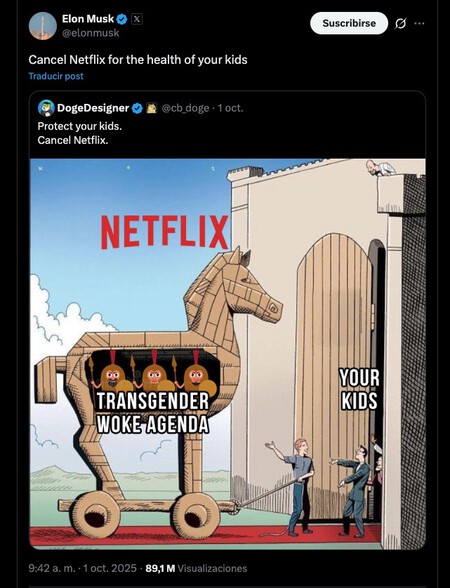
Musk’s post on X quickly went viral, urging users to “Cancel Netflix for the health of your children,” galvanizing thousands to share screenshots of their canceled accounts. Following Musk’s call, many influencers aligned with Trump and MAGA sentiments echoed similar sentiments.
The Series and the Debate Over LGTBI+ Representation. “Dead End: Paranormal Park” is a blend of comedy, horror, and fantasy that follows Barney and his friends—diverse characters—on their adventures in a haunted theme park. The series has received accolades like the British Animation Award and the Glaad Media Award for its representation of LGBTI+ characters , and it has sparked debate among conservative viewers over whether its content is suitable for young audiences.
The uproar, however, traces back to an entirely different origin: the author, Hamish Steele . Steele faced backlash after criticizing a previous message from the British Prime Minister offering condolences for the death of Charlie Kirk , a conservative influencer who was killed at a public event. This condemnation fueled outrage among the conservative community, leading many to cancel their Netflix subscriptions in protest.
Touch the image to access the original message
Musk’s response to one of the critiques, describing the cancellation as a reaction to the author’s comments about Kirk, played a pivotal role in triggering the wave of cancellations. The subsequent backlash against LGTBI+ representation escalated into a perfect storm, all fueled by Musk’s influential presence.
The Financial Fallout for Netflix. The monetary ramifications of Musk’s boycott became immediately evident. By October 1, Netflix shares had already dropped by 2% , continuing to decline to a cumulative 4.4% decrease within just 48 hours.
Despite the obvious impact on their share prices, Netflix has yet to issue any official statements or clarify the actual effect on subscriber counts amidst this uproar.
The Personal Dimension of the Controversy. Musk’s views on this topic may be influenced by personal experiences. His daughter, Vivian Jenna Wilson , who he had with his first wife Justine Wilson , identified as a transgender female and sought a legal separation from the Musk family name. Vivian publicly stated, “I no longer live with my biological father or want to be linked to him in any way.” Their strained relationship became apparent when Musk proclaimed, “My son, Xavier, died. He was killed by the ‘Wake’ mentality virus.” Vivian has since publicly responded to her father’s comments, stating, “I only find out about him through social media,” revealing the emotional distance between them.
This controversy isn’t just about a Netflix series; it opens up broader discussions about LGTBI+ representation , societal values, and the impact of celebrity influence on public opinion. As the conversation evolves, it will be interesting to see how both Netflix and Musk navigate this challenging landscape and what it means for users and viewers alike.