

The Enigma of Dark Matter: Rethinking the Universe’s “Invisible Glue”
For decades, cosmology has depended on a fundamental yet elusive concept: dark matter . This invisible force , according to the standard model, binds galaxies together and prevents stars from flying apart due to centrifugal forces . Representing approximately 27% of the universe, dark matter remains undetected—its existence is inferred solely from the gravitational effects it has on visible matter. However, a new study published in Galaxies is disrupting this long-held belief.
The Study: A Radical Idea
Led by physicist Rajendra P. Gupta from the University of Ottawa, the research proposes a groundbreaking idea: what if dark matter does not exist? Gupta’s work suggests this ghostly component may be nothing more than an illusion —a byproduct of a long-assumed principle: that the fundamental constants of nature remain constant over time.
The Importance: A Historical Perspective
To grasp the magnitude of this proposal, one must go back to the 1970s. It was during this time that astronomer Vera Rubin uncovered that stars located on the edges of galaxies rotate at the same speed as those near the center. This observation directly challenged Newton’s laws of motion , indicating that if the universe obeyed these laws, a significant gravitational force was missing. The scientific community nailed down one possible explanation: the existence of dark matter, an invisible mass that supposedly generates the extra gravity needed to keep galaxies intact. This concept has since become the linchpin of the cosmological model known as ΛCDM (Lambda-Cold Dark Matter).
The ΛCDM model has proven remarkably effective in explaining large-scale cosmic phenomena, yet after decades of searching with advanced detectors and experiments conducted at the Large Hadron Collider (LHC), no particle of dark matter has ever been confirmed. We have only “detected” it through its gravitational effects on observable objects.
The Proposal: Gupta’s Model
Enter Gupta’s knight-in-shining-armor concept. His model, dubbed CCC + TL (Covariant Coupling Constants + Tired Light), rests on two pillars.
The first idea is centered around Covariant Coupling Constants (CCC). Gupta proposes that fundamental constants, such as the speed of light (c) and the universal gravitational constant (G), are not fixed but rather evolve as the universe expands. While this concept was previously considered by physicist Paul Dirac , Gupta integrates it into a complete cosmological framework.
The second essential idea is derived from the controversial hypothesis of “tired light.” Initially proposed decades ago, this concept theorizes that light loses energy during its journey across space. In Gupta’s model, he suggests that the redshift of light from distant galaxies may result not just from the universe’s expansion but from a combination of both this tired light effect and evolving constants. While the tired light theory has been widely critiqued, its inclusion in Gupta’s hybrid model is crucial for his mathematical predictions.
New Terms: The Emergence of α-material and α-energy
With these two innovative ideas, Gupta alters Einstein’s field equations, giving rise to new mathematical terms he refers to as α-material and α-energy . Here’s where Gupta’s proposal becomes truly groundbreaking: these parameters, which are not physical substances but rather effects stemming from the evolution of physical laws, create the extra gravitational pull that had previously been attributed to dark matter. In essence, dark matter could merely be an illusion created by mathematics.
Testing the Hypotheses: Using the SPARC Database
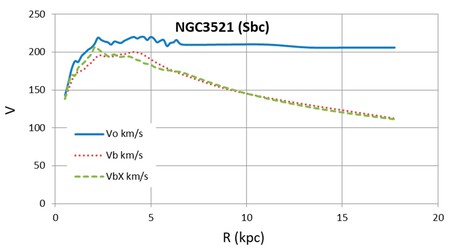
To validate his model, Gupta utilized the SPARC database , a high-quality catalog containing the rotation curves of 175 galaxies. Unlike conventional methods that introduce dark matter to explain rotation curves, Gupta’s approach elicits the observed curves and subtracts the effects of α-material.
For example, consider the galaxy NGC3198. Gupta’s model provides a framework to compare the actual rotation speed , represented by a blue line (VO), against what should be expected if only visible matter existed, shown by the orange dotted line (VB). Meanwhile, the predicted curve from the Gupta model is represented by the dashed line (VBX). The remarkable similarity between the model’s predictions and actual observations indicates promising results.
A New Paradigm: Implications of the CCC+TL Model
If Gupta’s CCC+TL model is validated, its consequences could be monumental. Not only would it eliminate the necessity of dark matter, but it could also potentially unravel other cosmological enigmas, including the nature of dark energy and why the earliest galaxies observed by the James Webb Space Telescope appear more evolved than anticipated.
Proceed with Caution: A Long Journey Ahead
It’s essential to note that this research is currently classified as a “proof of concept,” meaning it employs certain simplifications, like treating galaxies as perfect spheres—an oversimplification of reality. Furthermore, incorporating the idea of tired light clashes with traditional cosmological views, which could prove uncomfortable for some in the field. Models like this must demonstrate they can equate the precision of ΛCDM in explaining critical observations, such as microwave background radiation and the accelerated expansion of the universe.
Nevertheless, the ongoing exploration within the scientific community, particularly in light of the unyielding complexities surrounding dark matter, signals an opening for innovative ideas. The Gupta model serves as a fascinating perspective—an invitation to reconsider entrenched truths and embrace the possibility that the universe’s greatest mysteries may arise from a deeper understanding of how we define reality . In science, the most foundational principles are often open to reevaluation, revealing that the landscape of knowledge is anything but static.