
OpenAI’s Ambitious Revenue Goals: The Path to 2030
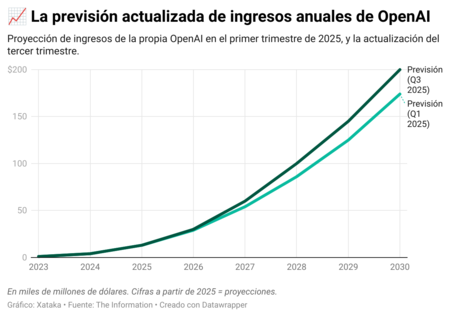
OpenAI is setting its sights on a staggering $200 billion in revenue by the year 2030. This figure is almost on par with Microsoft’s current annual revenue of $245 billion. As OpenAI anticipates reaching $12 billion this year, the company believes it can multiply its income more than 17 times within just five years. This is particularly striking when we consider that it took Apple four decades and Google two decades to achieve similar revenue figures. In contrast, OpenAI is poised to do so in less than 15 years of existence, especially considering that until just three years ago, it had not generated even $100 million in revenue. The significant turning point for OpenAI came in 2022, often referred to as its “zero moment.”
The growth trajectory, as illustrated in a graph published by The Information, showcases many intricate layers. One key observation is that while OpenAI’s revenue is projected to skyrocket, the associated computing costs—both for training and inference—are expected to grow at a linear rate.
The Business Model Transformation
For OpenAI’s ambitious projections to materialize, it must evolve beyond its current model of selling access to its Large Language Models (LLMs) for $20 per month. Instead, the firm needs to transition into something far more expansive. The question then isn’t just whether OpenAI can multiply its income by 17 times, but rather what innovations they need to devise to justify such assessments.
The revolutionary idea stems from agents. Contrary to popular belief, OpenAI’s aspirations do not solely revolve around enhancing a smarter ChatGPT. Instead, they aim to replace entire departments in organizations. OpenAI’s Deep Research initiative hints at this model, proposing a shift from charging by consultation to billing based on work completed.
Imagine a report that traditionally required three junior analysts a week to compile now being produced by an agent in mere minutes, supervised by just one employee. The value of that report wouldn’t be priced at $20; rather, it would be worth the $50,000 it costs to employ those analysts per week.
The Fortune 500 Influencer
When we consider the immense impact this has across each department of the Fortune 500 companies, the projection of $200 billion suddenly feels achievable, perhaps even conservative. However, an existential paradox looms for OpenAI: to capture that value, their models need to be irreplaceable, unique, and unattainable.
Yet, as each month passes, the gap between OpenAI and competitors like Claude, Gemini, or DeepSeek narrows. The threat of commoditization is not a distant forecast but a reality already unfolding. How can OpenAI justify premium pricing for its product when it risks becoming as ubiquitous as water or electricity? The company’s apparent strategy focuses on speed:
- Arrive first.
- Dominate the market.
- Create dependency before others react.
This approach mirrors strategies employed by companies like Uber and Amazon, which initially operated at a loss to secure market share, banking on becoming the only player left standing when profitability arrives.
Vertical Solutions and Market Capture
OpenAI’s alternative plan revolves around developing vertical applications. Rather than offering generic solutions, the company will focus on creating specific systems tailored to individual needs:
- The complete customer service solution for companies.
- The educational platform for universities.
- The legal co-pilot for law firms.
Each of these verticals presents a new market worth billions. This is where the financial projections become more plausible. For context, Microsoft 365 currently generates nearly $100 billion annually. The global business software market is approaching a trillion dollars. If OpenAI manages to capture just 20% of this market by replacing traditional software with intelligent agents, it could reach its ambitious revenue target without needing to reinvent the wheel.
The Time Factor: A Delicate Gamble
OpenAI’s primary gamble appears to hinge less on pioneering technology and more on timing. The organization is investing heavily in $350 billion worth of computing costs, betting that Artificial General Intelligence (AGI) or an equivalent breakthrough will arrive before their funding is exhausted.
If successful, the projected $200 billion in revenue will be seen as a mere anecdote. However, if they fail, we may witness one of the most remarkable bubbles in technological history.
What’s intriguing is not just OpenAI’s audacious plan but the overwhelming belief among significant stakeholders—including Microsoft, Oracle, Softbank, and even the US government—that these goals are indeed attainable.
The unfolding story of OpenAI is a compelling case study in ambition, technology, and market dynamics, revealing a landscape that is not just about what is technologically possible but also what is economically viable.