
Alibaba Launches QWEN3-OMNI: A Revolutionary Open Source AI Model
The Chinese giant Alibaba has launched officially QWEN3-OMNI, marking a significant milestone in artificial intelligence. This model is groundbreaking as it can process text, images, audio, and video simultaneously . By unifying these four modalities natively, Alibaba’s QWEN3-OMNI is the first in its category to offer such capabilities entirely for free, setting it apart from its competitors in the U.S.
Bet on the Free Code. While established players like OpenAI and Google charge for their advanced multimodal models, Alibaba provides QWEN3-OMNI under the Apache 2.0 license . This approach allows any company or individual to download, modify, and use the model commercially at no cost. This open-source strategy is not just a trend; it’s a critical part of China’s ambitions to remain at the forefront of the AI landscape while attracting global interest in its language models from developers worldwide.
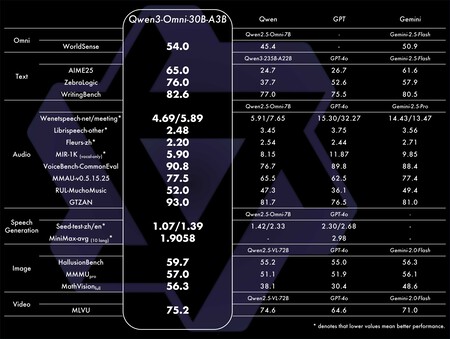
Image: Alibaba
What Can You Do Exactly? QWEN3-OMNI boasts the capability to process text in 119 languages , recognize voice in 19 languages , and even articulate responses in 10 languages . Its “thinker-speaker” architecture separates the reasoning from audio generation, promising real-time responses with latencies of just 234 milliseconds for audio and 547 milliseconds for video.
Benchmarks. In a series of 36 benchmark tests , QWEN3-OMNI has surpassed other open-source models in 32 of them, establishing new records in 22 . For instance, it scored 65 points in advanced mathematics (AIME25) compared to 26.7 for OpenAI’s GPT-4O. Similarly, in writing tasks (Writingbench), it attained 82.6 points, outperforming GPT-4O, which scored 75.5 . Although it hasn’t been compared to OpenAI’s most advanced model yet (GPT-5), Alibaba’s achievement highlights the potential of open-source technology in AI.

Strategy. Alibaba is executing a bold yet sensible strategy: democratizing multimodal AI to seize market share. “This could bring substantial shifts to the landscape of open-source models,” explained the QWEN team. This announcement arrives as NVIDIA unveils a staggering $100 billion investment in data centers to support OpenAI. In contrast, Alibaba and other Asian giants are pursuing technological leadership from a different angle, focusing on accessibility and innovation.
What Does It Mean? Major American tech companies have predominantly opted for proprietary models that yield direct revenue streams. Alibaba seeks to alter this paradigm by providing instant access to its technology for millions of developers. While they offer it for free, they are crafting an ecosystem that positions them favorably in the long run, effectively shaping the future landscape of AI.
And Now What? China isn’t the sole country embracing free code models. OpenAI has introduced GPT-Oss and Google is working on Gemma . These alternatives allow developers to launch their innovative ideas while contributing to the shape of future AI technology. However, for companies like Alibaba, Deepseek, or Tencent, the focus remains on open-source options, and they do not hesitate to make their more powerful models available at no cost.
QWEN’s models have garnered a strong reputation over the years and this latest evolution marks a significant milestone in the AI field. It sets a new standard, not only in efficiency but also in how businesses can operate within this changing technological landscape. With Alibaba’s approach, the potential for growth and transformation in the AI sector is more promising than ever.
Cover image | Alibaba and Growika
In Xataka | Eight people. An hour of work. A budget dollar. 5,000 new podcasts thanks to AI