

The Haunting Tragedy of the Cobalt-60 Capsule in Mexico City
27 years before the devastating disaster in Chernobyl , a family in Mexico City faced a tragic fate associated with ionizing radiation. The striking parallel to the death of Marie Curie —who succumbed to ailments caused by exposure to radioactive materials—was not lost on observers. A Mexican family experienced a horrific decline in health after unknowingly being exposed to a radioactive Cobalt-60 capsule found in their home.
The Discovery
In March 1962 , a family consisting of five members—a father, a pregnant mother, a grandmother, a daughter, and a son—moved into a new residence in Mexico City. While playing in their garden, one of the children discovered a seemingly harmless capsule . At merely ten years of age, the child had no means of recognizing the hazardous nature of the object, which lacked any identifiable warning labels.
The Capsule’s Deadly Nature
Unbeknownst to them, this Cobalt-60 capsule , measuring just a few centimeters, emitted 200 gigabequerelios (GBq) of radiation. To provide a startling comparison, this is a radiation level significantly lower than the catastrophic events at Chernobyl, yet still powerful enough to inflict devastation without proper safeguards in place. Tragically, the handling of this isotope was far from safe.
Similar to the unfortunate trajectory of Marie Curie approximately thirty years later, the child unwittingly carried the capsule in their pocket for days, absorbing a significant dose of ionizing radiation . The mother, not recognizing the danger, placed the capsule in a kitchen drawer. This choice, of course, proved inadequate for containing such lethal radiation, highlighting the sheer ignorance of safety protocols at the time.
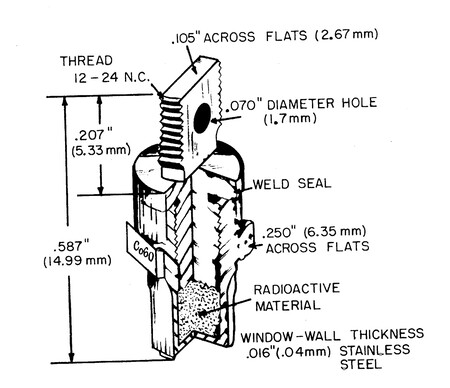
The piece
Signs of Distress
As days passed, alarming signs began to manifest within the household. The mother observed that glass objects within their home were inexplicably changing color—a phenomenon known as radiation solarization . This occurs when transparent materials, like glass, become altered due to exposure to high-energy radiation. It was an early, ominous indication that something was terribly wrong.
Mysterious ailments began to afflict family members, starting with fatigue and escalating to severe symptoms, including vomiting. Tragically, within days of discovering the capsule, the young boy succumbed to the extensive radiation exposure that wreaked havoc on his bone marrow , leading to infections and necrosis in his bone tissues.
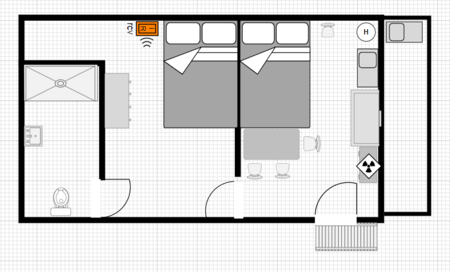
A layout of the home where the tragedy occurred, with the location of the capsule marked by a radiation symbol
The mother, having spent considerable time in proximity to the capsule, passed away in July due to hemorrhages in her hematopoietic tissues. Tragically, the family’s youngest daughter died in August from a respiratory infection, compounded by anemia and leukopenia. The grandmother followed suit in October , experiencing similar symptoms. Fortunately, the father, who had spent less time at home due to work commitments, miraculously survived despite also being exposed to high levels of radiation.
The Quest for Answers
In the short span of eight months, this tiny radioactive capsule led to the demise of five family members. The pressing question remains: how did such a hazardous object end up unprotected in the garden of a family home, especially considering there were existing safety regulations surrounding radioactive materials? Even after 60 years , no official explanation has emerged.
The capsule was reportedly removed from a hospital where it had been used in radiology equipment and was improperly transported without adequate safety measures. This has led to various theories suggesting the capsule inadvertently found its way to a landfill alongside other refuse, lacking any labeling to warn of its dangers. A medical report from 1964 indicated that the capsule had been sealed in a lead container given to the family for “safekeeping,” yet they were not informed of its hazardous contents.
More Than a Single Incident
This tragic incident sparked various conspiracy theories, with speculation that it could have been a premeditated event targeting the family. Despite its unsettling narrative—mysterious deaths and changing colors in household items—there has been little attention given to this case compared to another incident involving a Cobalt-60 capsule in Ciudad Juárez in 1984 .
In that case, improper dismantling of a radiotherapy unit resulted in the release of cobalt-60 particles, subsequently contaminating construction materials that left a scar of destruction across thousands of homes in Mexico and beyond. While it’s estimated that around 4,000 people were exposed without immediate catastrophic consequences, this underscores the critical need for stringent safety measures in managing obsolete medical equipment.
This ill-fated episode, reminiscent of ghostly tales, serves as a grim reminder of the potential repercussions of neglecting safety protocols in handling radioactive materials. The lessons learned from these incidents remain essential for the future of public health and safety.