
The Dynamics of Europe’s GDP: An In-Depth Analysis
Gross Domestic Product (GDP) serves as the primary indicator of a country’s economic size and growth. Traditionally, it reflects the total value of goods and services produced within a territory, enabling comparisons of economic performance across various regions. Recently, however, GDP has garnered increased attention due to the war in Ukraine, defense demands from the US, and the rearming of Europe. Thus, delving into the current state of Europe and comparing the GDP of its various nations offers a crucial perspective on the economic health of the continent.
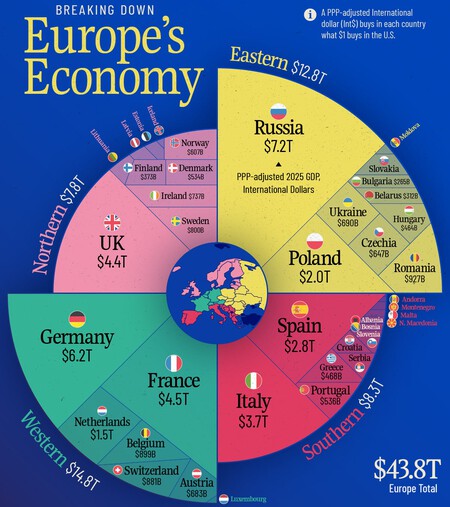
The graphical representation curated by Visual Capitalist and utilizing data from the International Monetary Fund vividly illustrates the economic stature of different European countries. Here, one important aspect comes into play: if a GDP figure appears misaligned—for instance, Spain’s GDP pegged at 1,593,136 million euros in 2024 versus 2,800,000 million dollars—it’s essential to consider the impact of Purchasing Power Parity (PPP).
Understanding Purchasing Power Parity
What is Purchasing Power Parity? Understood as a method of adjusting economic figures, PPP permits a more accurate comparison of the price and value of goods and services across nations. The graph emphasizes GDP figures adjusted for PPP, allowing us to gauge economies and their respective purchasing power more realistically. This adjustment mitigates distortions inherent in foreign exchange markets, granting us a clearer picture of living standards and economic wellbeing in different countries.
The philosophy behind PPP is straightforward: it enables a genuine assessment of what can be purchased locally instead of simply converting GDP figures into a standard currency, typically the US dollar. By employing a more equitable exchange rate, the graph effectively showcases how economies with overvalued or undervalued currencies relate to the global economy.
Regional Economic Performance
Countries such as Germany, the United Kingdom, and France stand out with their substantial GDPs adjusted for PPP, while nations like Italy, Spain, Poland, and the Netherlands hover just above the 1 trillion dollar mark. But a noteworthy point arises when we distinguish between various European regions. The economic heft of Russia and Germany becomes apparent, with Western Europe holding a GDP adjusted for PPP of 14,800,000 million dollars, contrasting sharply with Eastern Europe’s 12,800,000 million dollars.
When observing Southern Europe—which encompasses the so-called “PIGS” (Portugal, Italy, Greece, and Spain)—the GDP adjusted for PPP rests at approximately 8,300,000 million dollars, while Northern Europe achieves 7,800,000 million dollars.

Despite seeming robust, the economic disparities remain glaring. Under nominal GDP metrics, Western Europe still showcases dominance with a figure of 11,000,000 million, whereas Eastern Europe sharply declines to 4,600,000 million. Although Russia contributes significantly to GDP adjusted for PPP, its nominal GDP drops it lower in the rankings, at 2,100,000 million.
Unequal Growth Across Europe
The variances in GDP growth highlight the historical trend of two-speed economic development within Europe. As we look at the latest data, regions such as Lithuania, Iceland, and Montenegro experience significant growth, while nations like Luxembourg, Ireland, and Estonia regress. Spain showcases a unique case where growth trends diverge from stagnancy observed in larger economies like France and Germany.
The growth rate across the Eurozone sits at approximately 0.7%, while the overall European Union rests at 0.8%. However, external influences, structural tensions, and industrial slowdowns across various member states complicate the projection of Europe’s GDP moving forward into 2025.
The ongoing geopolitical climate, shaped by the lingering effects of the Ukraine conflict and calls for enhanced military readiness, adds further uncertainty to Europe’s economic future. As the continent grapples with these myriad challenges, understanding GDP—both adjusted for PPP and nominal—is essential for grasping the full picture of economic health across Europe. The economic narratives being shaped today will undoubtedly influence not just policy decisions but also the broader outlook for nations striving for a more unified economic future.