
The Rise of Humanoid Robots: China’s Ambitious Leap into the Future
The first ever “Olympic Games” for humanoid robots, held in Beijing last month, has brought global attention to one of China’s most assertive technological ventures. Amidst various sports exhibitions and industrial demonstrations, China showcased its advancements in the creation of humanoid robots. However, the journey towards achieving reliable and market-ready robotic solutions is riddled with challenges, underscoring that not everything can be achieved through mere promises .
The Strategy from China
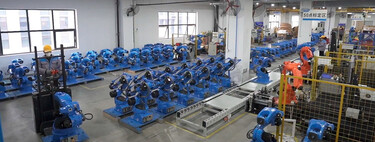
Beijing has prioritized humanoid robotics as a key area of focus. Its five-year plan for the robotic sector, set forth in 2021, anticipates an annual growth rate exceeding 20% . This ambitious initiative is supported by a state fund exceeding $140 billion aimed at fostering technological startups . China aims to lead what it considers the “next great technological revolution” following innovations in smartphones and electric vehicles. This year, they target the production of over 10,000 humanoid robots , with significant investments concentrated in cities like Shanghai , Shenzhen , and Beijing .
<img alt="China's industrial robots innovation" width="375" height="142" src="https://i.blogs.es/41a043/robots-industriales-china/375_142.jpeg"/>The Perfect Showcase
The recent “Olympic Games” for robots served as a remarkable demonstration of strength . One of the most distinguished moments was when the Unitree H1 robot completed 1,500 meters in just 6 minutes and 34 seconds , boasting a speed of 4.78 m/s —a performance that surpassed Boston Dynamics’ Atlas robot. However, a critical detail that many observers overlooked was that these robots were not operating autonomously; they were remotely controlled by human operators.
The Blow of Reality
While China flaunts its achievements, even inaugurating the first “Robot Mall” in Beijing—an innovative establishment that promises sales, spare parts , and service for humanoids —many experts urge caution. “I don’t think anyone has identified a need for humanoids that requires thousands to be installed,” asserts Melonee Wise, a former product director at Agility Robotics, in a statement to IEEE. The lack of current demand represents a significant barrier to the mass production of humanoid robots.
Pending Technical Issues
Another major hurdle is energy autonomy . For instance, the Agility Digit robot requires 9 minutes of charging for every 90 minutes of operation, often needing to pause every 30 minutes for safety reserves. Achieving industrial reliability demands standards of 99.99% , a far cry from current capabilities in versatile applications. There are unique safety challenges; for example, the unexpected shutdown of a bipedal humanoid robot, weighing several kilograms, poses considerable risks.
A Market that Still Does Not Exist
While companies like Bank of America Global Research predict 18,000 units of humanoid robots to be sold by 2025 —with estimates soaring to 1 billion robots by 2050 in a market projected at $5 billion , according to Morgan Stanley Research—the reality is starkly different. Currently, there are very few actual commercial deployments, with even the most advanced companies struggling to utilize their robots beyond controlled pilot tests . The potential applications that could justify these lofty projections remain largely speculative.
<img alt="China's autonomous robots in action" width="375" height="142" src="https://i.blogs.es/e53501/ps---plantilla-portadas-xtk/375_142.png"/>The Closest Commercial Launch of Europe
In contrast to China’s optimism, European firms like Neura Robotics are making strides in the sector with 4NE1 , a domestic robot planned for launch at approximately €60,000 by 2026 . The CEO of Neura Robotics envisions their creation achieving a significant impact in robotics, akin to what the iPhone did for smartphones. While the domestic market appears to be the most viable for these types of robots, such an investment represents a considerable financial commitment.
Known Companies Betting on the Long Term
Chinese corporations like Xiaomi and Honor are diversifying into the humanoid robotics segment, mirroring Amazon’s strategy of absorbing initial losses to ultimately dominate the market. Given the competitive smartphone environment, this strategy seems prudent, provided that initial promises evolve into functional and profitable products .
Hype or Revolution?
China is massively investing in an incipient market, banking on artificial intelligence to resolve the challenges of autonomy, reliability, and practical applications of robots. As Wise points out, “The reality is that AI is not robust enough to meet current market demands.” Indeed, the capabilities of humanoid robots remain limited today, but only time will reveal whether their evolution can ignite a thriving market.
Cover image: China Daily
In Xataka | You cannot climb to the Madrid subway with an electric scooter. In China’s, robots are already passengers.