
Oil Remains a Dominant Force in Global Energy Consumption
Despite the surge in renewable energy sources, oil remains the primary fuel driving the world’s economy. Recently, major oil companies have reversed their strategies towards decarbonization , realizing that fossil fuels still offer substantial profits in the near term. The demand for oil is projected to continue rising, highlighting its entrenched position in the global energy market.
The chart below showcases the largest oil consumers from the previous year, providing visual insight into global consumption trends.
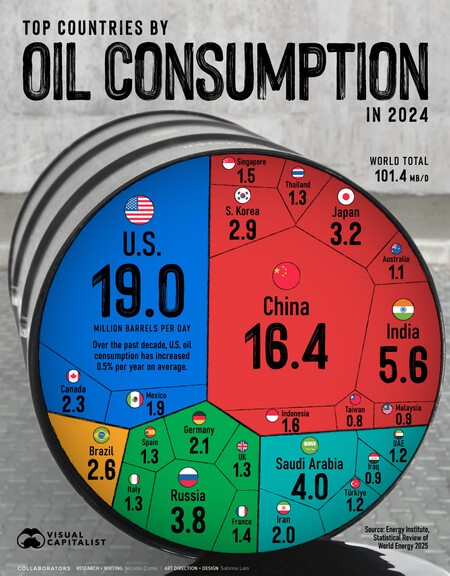
According to data from the Energy Institute, the graph created by Visual Capitalist illustrates the top 25 countries with the highest daily oil consumption for 2024. The estimated global consumption is set at 101.4 million barrels per day, with the United States and China leading at 19 million and 16.4 million barrels per day, respectively, showing significant gaps from the other countries.
The color differentiation in the chart highlights that the Asia-Pacific region consumes the most oil. Furthermore, aside from the colossal consumption figures from the U.S. and China, only one South American country made it into the top 25, while Europe’s consumption, excluding Russia, reflects a balanced distribution.
Looking at the data, the top 10 consumers— USA, China, India, Saudi Arabia, Russia, Japan, South Korea, Brazil, Canada, and Germany —account for 61% of the global consumption. This figure climbs to 80% when considering the top 20 countries, indicating a heavy concentration of demand. Notably, oil consumption saw an annual increase of about 0.7% worldwide .
The reliance on oil persists despite the global shift toward renewables. Recently, the International Energy Agency ( IEA ) adjusted its forecasts, projecting an increase of 1.6 million barrels per day , predicting demand to elevate to 103.9 million barrels per day by 2025. This trend underscores the significant role oil continues to play in global energy landscapes.
Understanding Oil Consumption Patterns
India’s oil consumption is particularly striking, having grown at a remarkable rate of 3.8% per year over the last decade . In the U.S., approximately 70% of oil is consumed within the transportation sector, with 24% utilized for industrial applications, leaving a modest 3% for residential and commercial use. In contrast, China’s oil usage sees a similar pattern, with around half dedicated to transport and substantial amounts consumed in industrial activities. Despite its heavy reliance on oil, China’s energy mix prioritizes coal, hydroelectricity, nuclear power, and renewables, making oil’s role marginal in its electricity generation.
The Future of Oil Demand
The dependency on oil is not only persisting but is expected to rise, with the IEA’s previous projection of an increase of 1.6 million barrels per day now aligned with OPEC+’s forecasts , which point towards greater crude oil availability. Adding to this scenario, China aims to expand its presence in oil production, highlighting the complexity of the oil market that is affected by both geopolitical factors and ongoing conflicts globally.
As we enter 2025, it is anticipated that the 101.4 million barrels consumed last year will be surpassed, and all eyes will be on India’s consumption developments. The interplay of geopolitical tensions and energy policies will shape the future of oil, making it a subject of constant interest and dynamic change.