
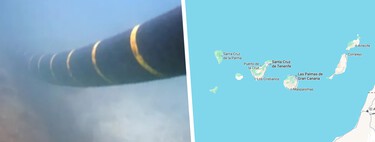
At first glance, the seas appear to be nothing more than an empty landscape . However, beneath the waves lies a complex and invisible network that supports our daily lives: the submarine cables that carry a staggering 99% of global communications . Now, a new generation of electrical interconnectors —spanning thousands of kilometers and powering gigawatts—aims to transport solar, wind, and hydroelectric energy to regions where it’s needed most. The promise is enticing: allowing electricity to travel along with the sun and wind. Yet, the execution of such ambitious plans is considerably more challenging.
The Starting Point: The North Sea
The foothold for this endeavor is the North Sea . At the end of 2023, the United Kingdom and Denmark inaugurated the Viking Link , a 765 km cable that traverses the North Sea, which allows the UK to import electricity during periods when wind energy is low and export surplus energy when available. Not only is it currently the longest operational interconnector in the world, but, as the Financial Times warned, its longevity remains uncertain.
British media sources have reported that even more ambitious plans are on the horizon: a 4,000 km cable designed to connect Canada with the United Kingdom and Ireland, a connection between Morocco and Europe, or the export of Australian solar energy to Singapore via an extensive underwater cable that spans over 4,300 km .
Through the Cables
This megaproject highlights that nations have been striving to connect renewable energies for some time now, as mismatches between production and consumption need to be addressed. A case in point is AapowerLink in Australia, wherein the Suncable company plans to install 3 GW of solar energy in the Northern Territory. Their plan includes storing some energy in batteries and selling it to both Darwin and Singapore through an underwater cable exceeding 4,000 km . According to their CEO, Ryan Willemsen-Bell , “Australia has abundant land and sun. The ability to share those benefits with our neighbors has enormous potential,” as stated by Financial Times.
Simultaneously, the North Atlantic Transmission One Link is working towards connecting Canadian hydroelectric plants with Europe. The time differential becomes a significant asset: while Canada sleeps, the United Kingdom starts its day, and when wind turbines churn in the North Sea at midnight, New York is preparing dinner.
A Lesson from the Internet
This concept may seem futuristic, yet solid precedents exist. As noted by Xataka , the Earth is crisscrossed by submarine data cables, authentic digital highways that have proven the feasibility of infrastructure spanning tens of thousands of kilometers. For example, the Southern Cross Cable Network , which stretches 30,500 km , connects Australia, New Zealand , and the United States since 2000. The recently launched 2Africa network encompasses 45,000 km , encircling the African continent and reaching as far as Barcelona and India .
In Spain, cables like Tide , which measures 6,605 km (created by Meta and Microsoft) and Grace Hopper at 7,191 km (from Google ), link Bilbao with the East Coast of the U.S. This experience with data networks draws a clear parallel: if we can transmit information on a global scale, why can’t we also move clean energy?
Challenges Ahead
However, the journey is fraught with challenges. According to the Financial Times, there are significant stresses on the supply chain. The production of cables, transformers, and converting stations is struggling to keep pace. Delays are becoming common, and there are few specialized ships available for laying cables.
Political issues also add layers of complexity. For instance, in Norway , the export of electricity has sparked internal debates regarding pricing. This year, the UK government opted not to support the X-Links project intended to transport energy from Morocco, citing a “high level of inherent risk.” Meanwhile, ongoing geopolitical tensions, highlighted by the Ukraine War , raise concerns about possible sabotage of critical infrastructure.
Looking Inside
In Spain’s scenario, the primary issue is more domestic than international. As detailed in Xataka , the country has rapidly advanced in the deployment of renewables in its “emptied Spain,” but it hasn’t effectively built the infrastructure needed to transmit that electricity to urban centers.
The outcome has resulted in a “broken bridge”: during peak solar hours, cheap megawatts are curtailed or sold at zero cost, while nighttime demand necessitates more expensive gas-fired power. According to data from the AELēC employer, 83.4% of connection nodes are already saturated, obstructing new connections, such as industries or data centers. Consequently, the challenge lies not just in planning and enhancing networks but also in improving interdependencies with neighboring nations to overcome the French bottleneck .
A Map of Interdependencies
Beyond technical and economic aspects, these electric highways redraw a geopolitical map . Just as pipelines defined 20th-century energy politics, renewable interconnections may define alliances in the 21st century. Engineer Simon Ludlam , co-founder of the Canada-UK project, succinctly stated, “The most important nuclear reactor is in the sky, and its energy can be shared thanks to the Earth’s rotation. But we need to be interconnected,” as reported in the Financial Times .
The sun shining in Australia’s deserts or the waterfalls in Canada could light cities thousands of kilometers away in mere moments. The energy transition depends not only on generating renewables but also on efficiently transporting them. If pipelines outlined the geopolitics of oil, these electric highways are poised to become the invisible arteries of our future world.