
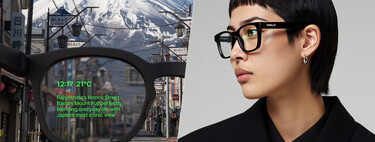
Amazon’s Strategic Leap into Augmented Reality Glasses
Amazon is gearing up to enter the augmented reality (AR) market with an innovative two-pronged strategy: developing a consumer model and a specialized version for its logistics distributors . According to reliable sources close to the company, Amazon plans to manufacture 100,000 units of the professional model, which is expected to launch in 2026. The commercial version is anticipated to hit the market between late 2026 and early 2027.
The Fashion Device
As highlighted by The Information, Amazon’s move into the AR realm will involve two distinct yet technologically aligned products. The consumer glasses, code-named “Jayhawk,” will reportedly feature a microphone, speakers, a camera, and a full-color screen designed for one eye. Conversely, the distributor model, known internally as “Amelia,” is set for a more durable construction aimed at assisting delivery personnel by displaying essential instructions directly onto the AR glasses screen.
There is Competition
Amazon’s entry is poised to position it directly against Meta , which is set to unveil the next version of its augmented reality glasses at an upcoming Connect conference. Meta’s smart Ray-Ban glasses, priced at €329 , already feature built-in AI, audio, and camera capabilities, albeit without a screen. Meta’s new offering, known as “Hypernova,” is expected to include a display for one eye, placing it in direct competition with Amazon’s Jayhawk.
Meanwhile, Chinese brands such as Xreal, Rokid, and Rayneo have already made inroads in the AR glasses market, while Google continues to develop similar prototypes, which were displayed during the last Google I/O conference. As the AR field becomes increasingly competitive, Amazon will need to differentiate its products to capture consumer interest.
Between the Lines
Amazon’s strategy to first create a model tailored for its logistics workers suggests an intent to utilize its own infrastructure as a testing ground before launching a commercial product. By trialing the professional model internally, Amazon aims to refine its technology within a controlled setting, allowing it to gather valuable feedback and demonstrate specific use cases. Furthermore, reports indicate that Amazon is collaborating with the Chinese firm Meta-Bounds for its screen technology, already favored by brands like Meizu for their AR devices.
The Technical Challenges
AR glasses present unique challenges compared to virtual reality (VR) models, which completely block out the real world. Amazon’s design will overlay digital information onto the user’s physical environment, which is a more complex endeavor. Opting for a screen in a single eye serves to mitigate costs and simplify manufacturing, although this choice may limit the overall immersive experience compared to dual-screen models. The consumer version is expected to be sleeker and less cumbersome than the professional variant, yet both models will share core technology according to The Information.
And Now What?
The success of Amazon’s ambitious AR venture will depend heavily on factors such as acceptance from logistics distributors , longevity of the battery life, the precision of the instructions displayed, and the overall software performance . Crucially, Amazon will need to create a user experience that surpasses that of its competitors. Fortunately, the company’s extensive logistics network provides an ideal environment to test and refine its AR technology before a broader commercial release.
With its entry into augmented reality, Amazon is preparing for a significant shift in both consumer and professional markets, ensuring that it remains at the forefront of technological innovation.