

Apple has recently held its traditional Keynote event, unveiling a series of exciting new devices for the upcoming months. Among the much-anticipated introductions are the refreshed Apple Watch families, including Series 11, SE 3, and Ultra 3. However, the highlight of the event was undoubtedly the introduction of the new AirPods Pro 3 . As usual, the main attractions were the newly launched iPhone 17 , iPhone 17 Pro , and iPhone Air , which aim to dominate the evolving landscape of ultra-slim smartphones.
While many updates felt conservative, Apple surprised us with a rare move— making significant changes to the iPhone 17 Pro. Firstly, the company has shifted its materials, opting for aluminum instead of the usual glass and titanium. This change aims to address long-standing issues with iPhone durability. Additionally, Apple broke its tradition by increasing the megapixels of the telephoto camera . For years, the iPhone has maintained a 12-megapixel telephoto camera, but now it proudly boasts a 48-megapixel sensor , albeit with a slight decrease in optical zoom from 5x to 4x compared to previous generations.
The 48 Megapixels of the iPhone 17 Pro Telephoto
While the mobile industry has been racing for higher megapixel counts —boasting cameras with 24, 48, and even 200 megapixels—certain brands like Google and Apple remained steadfast in their philosophy. They firmly believed that 12-megapixel sensors had the advantage of larger pixel sizes, which improved light capture while enabling efficient computational photography without long processing times or bloated file sizes.
Increasing megapixels indeed impacts photo quality. A 12 MP image processes differently than a 50 MP one. Smaller pixels may come with higher megapixels but suffer from light capture, resulting in inferior outcomes in both bright and dark conditions. Nonetheless, the day of reckoning arrived: Google integrated a 50-megapixel sensor in its Pixel 6 Pro , prompting Apple to follow suit with its 48-megapixel implementation in the iPhone 14 Pro .

The increase in megapixels allows users to utilize a 2x digital zoom through sensor cropping, a technique termed “zoom with optical quality” rather than “optical zoom.” This technique leverages the main camera while virtually cropping the sensor to achieve a 2x magnification. The quality of these digital zooms is often indistinguishable from true optical ones, creating a scenario where Apple’s advancements have the potential to match or exceed competitors, despite their prior reliance on the 12-megapixel telephoto.
This transition will drastically improve digital zoom quality and offers users more versatility in their photography. Apple’s bold decision comes as a timely response to mounting competition, aligning with the growing trend of computational photography within the mobile industry.
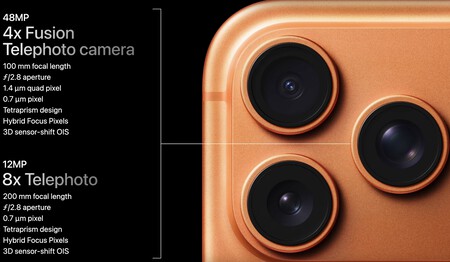
Apple emphasizes that with the iPhone 17 Pro, users essentially have “eight professional lenses in their pocket.” This versatility stems from its three-camera setup:
- Wide-angle (0.5x)
- Main (1x)
- Telephoto (4x)
By manipulating sensor cropping and introducing macro mode through the wide-angle lens, users can capture hybrid photos at 1.2x, 1.5x, and 2x . The introduction of an 8x hybrid zoom , utilizing the 48-megapixel telephoto sensor, marks a significant leap forward. Additionally, Apple has designed this telephoto sensor to be 56% larger, enabling better light capture for improved performance.

This change indicates Apple’s acknowledgment of evolving trends and demands in mobile photography. The camera capabilities of the iPhone 17 Pro position it competitively against devices like the Honor Magic V5 , Google Pixel 10 Pro , and Samsung Galaxy S25 Ultra . Although some may perceive this shift as a retreat from previous optical capabilities, the improvements in hybrid and digital zooms could redefine user experiences positively.

Capturing images showcasing hybrid zoom quality | Photo: Xataka
In an age where generative artificial intelligence is making its mark in mobile photography, Apple’s innovation comes at a crucial time. The specifications claim that digital zoom can extend up to 40x, but it remains to be seen how effective it will prove in practical scenarios. As users eagerly await real-world tests, the upcoming iPhone 17 Pro promises an exciting new chapter in smartphone photography.