
China’s Demographic Shift: Implications and Innovations
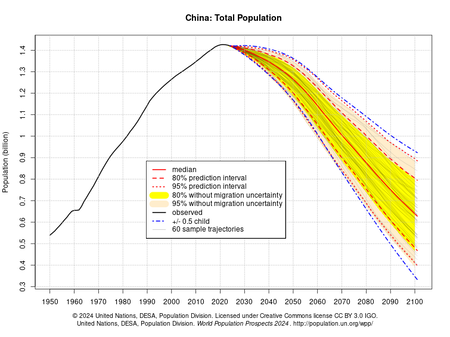
In 2024, China’s population surpassed 1.4 billion individuals, yet projections from the United Nations indicate that this number is set to decline sharply in the coming decades. By 2050 , estimates suggest that China may lose between 100 and 200 million residents. Looking further ahead, projections indicate that by 2100 , the population could potentially dwindle to just 900 million . This demographic decline poses significant challenges, especially concerning the available workforce .
Source: United Nations
According to the Economist, the demographic challenge is further exacerbated by the fact that 22% of the Chinese population is currently over 60 years old . By 2035 , this figure is projected to rise to 32.5% . Compounding the issue, China’s birth rates are alarmingly low. To sustain its population, a rate of 2.1 children per woman would be necessary, yet in 2024, this rate was merely 1.0 . As pointed out by Trivium China, this demographic shift threatens to push China into what is termed the “average income trap.” The implication is clear: without an expanding workforce, China’s economic growth will inevitably slow, significantly impacting its position in the global economy.
Boosting Productivity in a Shrinking Workforce
To counter this declining workforce, Chinese authorities have identified a strategy termed the “new quality productive forces” (NQPF) . This initiative aims to enhance productivity through innovation, better education, and the dissemination of new ideas across various industries . In April 2024, President Xi Jinping indicated that the upcoming fifteenth five-year plan (2026-2030) will focus on these progressive measures.
AI Plus Initiative: A Technological Leap
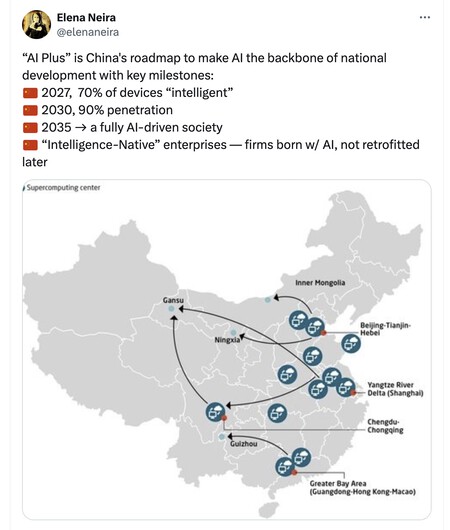
Central to this strategy is the AI Plus initiative, a plan set to integrate artificial intelligence into China’s economic framework over the next decade. The initiative aims for AI to permeate key sectors including science and technology , industry , and consumer markets . According to the plan:
- By 2027 , over 70% of terminals and intelligent agents will engage in crucial sectors.
- By 2030 , this penetration should reach 90% .
- By 2025 , AI is projected to become as integral to society as electricity and the Internet .
The initiative envisions AI as a transformative force across various domains, from scientific discovery to industrial transformation . Agriculture and services are prioritized for AI deployment in the immediate future.

Consumption, Governance, and International Competitiveness
In the consumer sector , AI is expected to stimulate demand through innovations such as connected cars and smart home devices . The overarching goal is for AI to assist citizens in education, healthcare, and productivity.
Moreover, AI’s role in governance entails enhancing national security , improving urban planning , and streamlining online censorship . The plan also positions AI as an international public good , advocating for an open-source approach to technology.
Challenges Ahead
Despite ambitious goals, experts express concerns regarding the feasibility of the AI Plus program . Jeffrey Ding , an academic from George Washington University, suggests that while China excels in technology innovation , it struggles to propagate these advancements throughout its economy. Additionally, a training gap persists; while elite universities produce top AI talents , fostered skills often do not translate to widespread adoption among regular engineers. A 2022 survey revealed that a mere 4.5% of state-owned enterprises felt their digital transformation efforts were meeting expectations.
The Focus on Practical AI
Interestingly, the AI Plus directive does not explicitly address the pursuit of artificial general intelligence (AGI) . This omission suggests a preference for immediate, practical solutions aimed at easing the demographic pressures rather than venturing into the uncertain territory of AGI. While the ambition exists, China currently prioritizes strategies that provide tangible benefits for its shrinking population, thereby navigating the impending challenges of its demographic contraction.