

Understanding AI Hallucinations: Why Chatbots Get It Wrong
Artificial Intelligence (AI) has made remarkable strides in recent years, particularly in natural language processing. However, even the most sophisticated AI models, such as those developed by OpenAI, exhibit a troubling phenomenon known as “hallucinations.” These occurrences manifest when AI generates responses that are entirely inaccurate or fabricated, often leading to confusion and frustration for users. Understanding the reasons behind these errors is crucial for improving AI systems and their reliability.
According to a recent report published by OpenAI, hallucinations arise primarily due to the “statistical pressures” present during the training and evaluation phases of AI development. The AI is often compelled to provide answers even in cases where it should acknowledge uncertainty. This can be likened to a student facing a tough exam question who guesses an answer instead of admitting they don’t know.
Good news, you don’t have to choose model using GPT-5. Bad news, it is GPT-5 who chooses it without notifying you.
One core issue with the AI’s training is the way it learns from vast text corpora. In the pre-training phase, AIs learn to predict the next word in a sentence based on patterns found in previous examples. However, these systems lack true/false labels for the sentences they generate, relying solely on positive examples of language. This approach increases the likelihood of producing inaccurate content.
The report cites a method to mitigate these hallucinations: implementing a binary classification system known as IIV (Is it Valid?) . This system would help determine whether a response is valid or erroneous, improving the model’s self-awareness. When this binary system is integrated into models like GPT-5, the AI shows signs of “humility,” with the ability to classify its answers as correct, incorrect, or an abstention. Preliminary data indicate that GPT-5 has made strides in reducing its hallucination rate; it is reported that 52% of its responses abstain from providing an answer altogether, compared to just 1% for its predecessor, O4-mini.
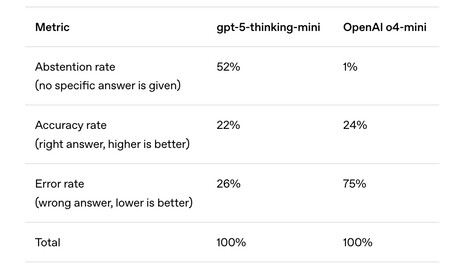
The research reveals a systemic issue: current benchmarks tend to emphasize successes while glossing over failures such as hallucinations. Amidst continual advancements, it appears that AI models are still prone to generating invalid information. There’s an urgent need to create a balanced framework that holds models accountable for both correct answers and the cases in which they should admit ignorance.
To draw parallels with a more familiar context, consider how educational assessments are structured. A strategy exists to discourage guessing by penalizing incorrect answers while offering neutral points for abstaining from answers altogether. Implementing a similar approach could reinforce accountability in AI models, discouraging inaccuracies while promoting the reliability of the responses.
The ongoing quest to enhance AI capabilities continues to evolve, with companies like OpenAI leading the charge. As the development of AI progresses, addressing the dilemma of hallucinations and implementing measures such as the IIV system will be essential in ensuring the responsible integration of AI into various industries.
While AI has already transformed numerous sectors, it remains essential to proceed cautiously, ensuring that users can trust the information these technologies provide. The future of AI hinges upon our ability to refine its development processes and enhance transparency, paving the way for a more accurate and reliable interaction between humans and machines.