
The World’s Largest Car Factory: Hyundai’s Ulsan Plant
On the southeast coast of South Korea, an installation has significantly redefined mass car production. The Hyundai plant in Ulsan is not only the largest vehicle factory in the world by area, covering over 485 hectares (equivalent to 680 soccer fields), but has also ingeniously integrated manufacturing , quality control , and global distribution into a seamless process. Today, this factory produces a new car every ten seconds.
The figures speak for themselves. With an impressive manufacturing capacity of 1.5 million vehicles annually, this facility doubles the vehicle output of countries like Italy, which has around 23 different factories. To put this productive capacity into perspective, the Ulsan plant could have satisfied 98% of all new car sales in Italy during 2024.
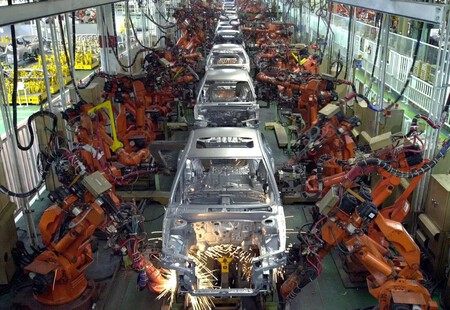
<span>Image: Hyundai</span>The secret is in integration. Ulsan’s uniqueness lies not only in its gargantuan size but also in its revolutionary concept : it is the only automotive plant in the world with an integrated port. Other factories need to transport vehicles to external ports, whereas Hyundai’s cars move directly from the production line to the ship, thus eliminating downtime and lowering logistics costs.
Mass production. The Ulsan facility operates five production factories, along with a dedicated plant for motors and transmissions, running their assembly lines for 18 hours a day. The factory manufactures 17 different models, including the Hyundai Santa Fe and Tucson, while planning to open a sixth exclusive plant for electric vehicles in the first quarter of 2026.
<img alt="Singapore Car Ownership" width="375" height="142" src="https://i.blogs.es/9cc1f8/meric-dagli-uii70orifpe-unsplash/375_142.jpeg"/>From the line to the ocean in minutes. Once vehicles pass quality control, they are driven to a massive parking area adjacent to the dock. Specialized drivers board large transport ships through steep ramps. After their load is secured, they exit on foot and drive a Hyundai Saria to the next assigned vehicle lot.
Complete urban transformation. The magnitude of the Ulsan plant has transformed the local community. When Hyundai broke ground in 1968, Ulsan was a fishing village with only 30,000 residents. Today, it boasts a population of 1.1 million and stands as South Korea’s industrial center . The influence of Hyundai is so prominent that a highway is named after the company’s founder, while hospitals, schools, and restaurants proudly display the brand’s name.
Giant numbers. Every 24 hours, a fully-loaded ship departs from the port of Ulsan. Approximately 75% of the plant’s annual production is exported to over 200 countries. Destinations such as California may receive up to 6,000 vehicles in a single shipment after a 13-day voyage across the Pacific. Directly employing 34,000 people, the plant now supports more residents than the entire city had when it first opened its doors.
An unrepeatable model. “Our unique production and export system saves both time and money, which is vital for our high-output capabilities,” said a plant representative. What began in 1968 as a simple assembly plant assembling the Ford Cortina by hand has evolved into the pinnacle of large-scale automotive production.
Cover image | Hyundai
As Hyundai continues to push boundaries in the automotive industry, its innovative approach serves as a benchmark for future manufacturing facilities worldwide.