
We have been imagining a future with robots that help us at home. From robotine of ‘The Supersonic‘ even Andrew from ‘The Bicentennial Man‘, fantasy has always been there, but it had never seemed so real. The advances in recent years have taken us to a point where automatons begin to touch the field of everyday life.
Figure AI, one of the most ambitious companies in humanoid robotics, has taken a step that brings that future closer. Their Figure 02 model, known as F.02, has shown that it can fold clothes, reorganize packages, and load a dishwasher: tasks that are simple for humans but tremendously complex for a robot.
A Jump That Redefines the Potential of Humanoids
Standing at 1.68 meters and weighing 70 kilos, F.02 is a fully electric robot with an autonomy of around five hours per charge. It can walk at a speed of 1.2 meters per second and transport objects weighing up to 20 kilos, placing it near the physical range of an average adult. These specifications demonstrate its potential to function effectively in everyday settings.
What makes this robot special is that F.02 operates without relying on human operators to execute its functions. Unlike Optimus, the Tesla robot unveiled during the ‘We, Robot’ event with various assisted capabilities, this model works autonomously thanks to an advanced artificial intelligence system called Vision Language Action (VLA), designed to interpret instructions and act independently.
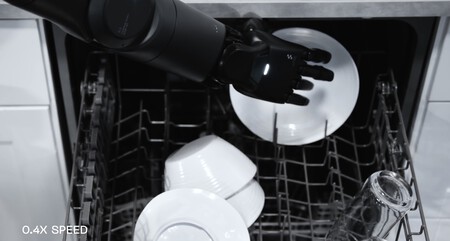
Another key feature is its capability to learn new skills from training data. The F.02 was initially able to fold clothes and move packages, but it has now incorporated the task of loading a dishwasher without requiring any redesign of its hardware or the creation of a new AI model.
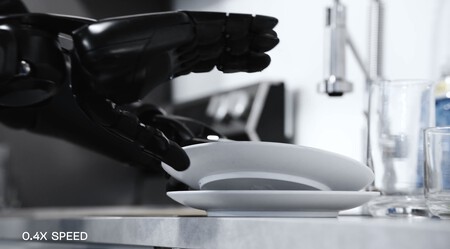
The company emphasizes that this task, though it seems trivial, presents substantial challenges: separating disordered items, reorienting them, and manipulating them with centimeter precision. Moreover, it requires coordinating both arms while handling fragile or slippery objects. Each dishwasher is unique, and every load can be likened to a puzzle that the system must adapt to in real time, addressing unexpected errors or collisions.
What’s fascinating is that all these achievements have been made with the same robot and the same digital brain, with the only addition being data. This paints a picture of a future where domestic robots can receive updates to expand their capabilities without needing to be replaced. They may even learn from their own experiences at home, bringing us closer to a realistic vision of autonomous robots that are genuinely useful in our daily lives.
Images | Figure AI
In conclusion, the advancements made in humanoid robotics, especially with models like the F.02, are leading us towards a remarkable future. The ability for these robots to learn and adapt will revolutionize household tasks, making daily life more manageable and efficient. As we continue to develop such technologies, the line between human tasks and robotic assistance will blur, paving the way for a new era of collaboration between humans and intelligent machines.