
There was a time when voice recorders were essential for journalists, students, and professionals who needed to register conversations. With the rise of the smartphone , they were relegated to a drawer corner. Today, artificial intelligence has returned them to the scene: compact and connected devices that offer automatic transcripts and summary summaries in seconds. What seemed like a dead category is now gaining attention from users and manufacturers, with proposals that modernize a classic tool.
The Startup Plaud , based in San Francisco and Shenzhen, has discovered the key to reinventing this classic device. Their Notepin , resembling a USB pendrive, allows for recording conversations and converting them into organized transcripts and automatic summaries. The recorder connects to an application that offers intelligent searches and answers to questions about the recorded content. Through this, Plaud aims to combine minimalist design and software to differentiate itself from the basic functions typically offered by mobile devices.
From Recorder to Notes with AI
Plaud has successfully turned a niche idea into a profitable business. Since its launch in 2023, the company has sold more than one million devices, according to Forbes. Their pricing model combines hardware with a subscription service: the Notepin costs 169.90 euros , while other models, such as the Note and Note Pro, reach prices of 169.90 and 189 euros respectively. With this formula, the startup aims to reach about $250 million in annualized income and boasts of profit margins close to 25% , comparable to those of the iPhone.
Plaud does not operate in a vacuum; the hardware sector infused with AI is experiencing a moment of effervescence . Forbes estimates that the market has received over $350 million in recent investments. Even Amazon has joined the movement, acquiring Bee, a startup focused on compact recorders for executives. The allure of having a personal assistant always on hand excites investors, but not all projects have seen positive outcomes, leading to warnings for the broader sector.
Rabbit is a prime example of unmet expectations. Its R1 was heralded as the future of interaction with AI, but initial excitement turned into disappointment when users realized its functionality was nearly identical to that of a mobile app. Similarly, Humane rolled out its futuristic AI Pin, aimed at replacing the phone, but it ended up being a costly failure. In contrast to these pitfalls, Plaud has carved a niche by concentrating on genuine productivity: recording, transcribing, and organizing information without the distractions often inherent in more ambitious technologies.
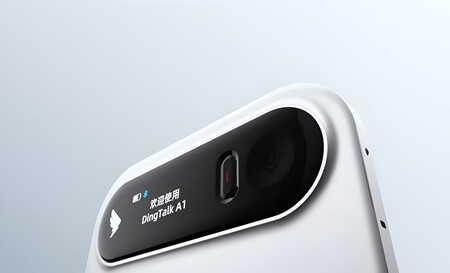
Dingtalk
China is also vigorously investing in this category. The South China Morning Post reports that Dingtalk , Alibaba’s business collaboration platform, introduced the A1 in August—a compact recorder capable of transcribing, summarizing, and translating conversations into over 100 languages . Built on the Tongyi AI lab, trained with over 100 million audio hours and specialized in 200 sectors , it offers a more affordable option starting at 499 yuan (approximately 60 euros ), yet is not available outside China.
The pressing question remains: if smartphones can record, why should one carry another device? Plaud discovered its niche by emphasizing features that mobile phones don’t offer effectively. Their recorders are equipped with dedicated microphones and extended battery life , ideal for lengthy meetings or interviews. The accompanying application features specific templates for professionals like doctors, lawyers, and sales representatives, simplifying workflows. This practical approach elevates the Notepin beyond a mere recording device—it’s a tool designed for professionals who rely on capturing information without interruptions.
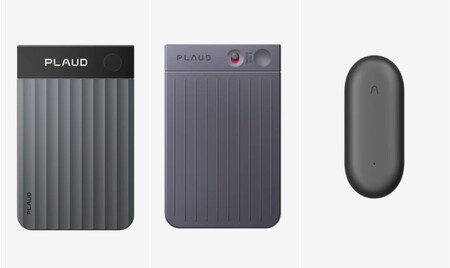
PLAUD PRODUCTS
None of these features come free. Plaud offers three plans: one basic, complimentary with limited functions, and two premium plans that unlock the device’s full potential. The Pro Plan costs 110.99 euros annually, allowing for 1,200 minutes of transcription monthly, as well as advanced templates and personalized summaries. The unlimited plan is priced at 249.99 euros per year, offering continuous recording and transcription alongside all platform capabilities. This structure reinforces the hybrid business model: attractive hardware paired with a subscription that transforms the device into a comprehensive service.
Recording conversations has evolved beyond journalism. Nathan Xu, Plaud’s co-founder, asserts that the device is designed as a professional tool , not a spy device . To emphasize this point, the Notepin includes a status light indicating when it is recording. In the United States, places like California prohibit recording without consent, potentially leading to fines or imprisonment, although enforcement of these laws is rare. The ethical debate over carrying around an always-on microphone is ongoing.
Plaud originated in Shenzhen, yet Xu aimed to strengthen its identity as an American company . The firm is registered in Delaware and operates out of San Francisco. A crucial detail, as outlined on their official website, is that user data is stored on servers located in the United States. This strategy appears to seek to alleviate concerns amid growing privacy tensions between Washington and Beijing.

The future of these recorders depends on numerous factors. Plaud has already begun exploring sectors such as healthcare , having acquired a hospital software startup to bolster its position against competitors like Open or Nuance , owned by Microsoft. This highly regulated market requires precision and security, which could favor specialized firms if they can earn user trust.
The resurgence of voice recorders is not merely a trend. Plaud has demonstrated that customers are willing to invest in tools that enhance their efficiency, even in an age dominated by smartphones. With companies like Alibaba ramping up their commitment, competition will become fiercer. These solutions must prove themselves as more than mere extensions of mobile functionalities but as a distinct category in their own right. What is clear is that the accuracy and potential of recording and processing have never been so promising.
Images | Plaud | Dingtalk
In Xataka | 100 million Tamagotchis in 30 years. The reason for being sold has a name: millennial nostalgia