
The Tax Agency has prepared a New Billing System for SMEs and Autonomous called Verifactu, part of Law 11/2021, known as the anti-fraud law. Its primary objective is for all invoices issued in Spain to comply with specific requirements, enabling them to be verifiable by the Tax Agency.
What is Verifactu?
Verifactu, with its official name written as Veri*Factu, defines a new billing system that aims to standardize how invoices are created and processed by businesses and self-employed individuals. This system is laid out in the Royal Decree 1007/2003, which mandates that all invoices must adhere to specific standards to ensure they are verifiable by the administration.
It is important to clarify that Verifactu is not billing software per se but rather a technological system designed to be embedded within billing systems. This implementation aims to prevent potential fraud, ensuring that each invoice issued is secure, unalterable, and traceable . Moreover, the Verifactu system will automatically relay all invoices to the Tax Agency, thus eliminating the possibility of dual-use software , which allows businesses to manipulate their accounting and hide actual sales.
Who is Obligated to Use Verifactu?
Verifactu imposes requirements on various businesses and freelancers. Here is a breakdown of those who must comply:
- Companies: This includes Sociedad Anónima, Limitada Company, Cooperatives, and any entity liable for Corporation Tax.
- Freelancers: All self-employed persons are affected, including those operating under the module regime.
- Revenue Attribution Regime Entities: This category includes communities of civil assets and societies.
- Foreign Companies with a Branch in Spain: Companies based elsewhere but operating in Spain through an office or branch must also adhere to Verifactu.

Who is Exempt from Using Verifactu?
While many businesses must comply with this new system, certain exemptions exist:
- Companies in the SII: Those participating in the Immediate Information Supply are exempt, as they report their revenue almost in real-time.
- Freelancers in Modules or Equivalence Surcharge: Exemptions apply only if a complete invoice is not issued.
- Agrarian Sector: Taxpayers recognized under the Special Regime of Agriculture, Livestock, and Fisheries are exempt, but only in specific agrarian receipts.
- The Basque Country: This autonomous region has its own taxation system called Ticketbai.
When Does Verifactu Take Effect?
Although Verifactu has been available since April for voluntary use, it will become mandatory starting next year. Companies must prepare much sooner than self-employed individuals, who have a longer time frame.
- Companies: Must comply by January 1, 2026.
- Freelancers: The deadline for compliance is July 1, 2026.
Non-compliance can result in fines up to 50,000 euros for companies, while software providers could face penalties of up to 150,000 euros for non-compliance.
How Does Verifactu Work?
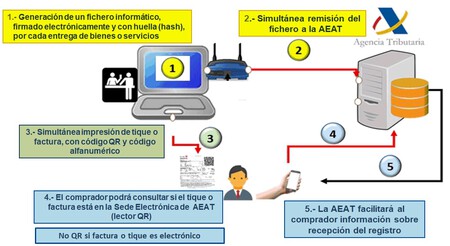
Image: Tax Agency
Verifactu is a system rather than standalone software . Businesses must acquire a Billing Computer System (SIF) that integrates Verifactu. While it’s not yet mandatory, developers were required to incorporate this system by July 1, which means numerous options already exist. Some examples include Quipu, Holded, and Stel Order. The workflow involves several steps:
- Invoice Emission: The basic issuance process remains unchanged, but the software used must be Verifactu certified.
- Registration in the AEAT: Each transaction sends key information to the Tax Agency.
- Recording Records: Every new entry links to the previous one, creating a chain that prevents alterations or deletions.
- Impression and Generation of QR: The invoice will feature a QR code and an alphanumeric identification code for added security.
What is the Price of Verifactu?
While Verifactu itself is free to use, the integrated billing software typically has a monthly cost . For instance, Quipu offers a basic plan starting at 14 euros, while Holded charges approximately 14.50 euros per month, and Stel Order provides a free plan for new users.
In summary, the introduction of Verifactu marks a significant shift in how invoices are handled within Spain, promoting transparency and reducing fraud. Companies and freelancers alike should prepare to meet the new requirements ahead of the mandatory deadlines.