

The recent arrest of Tarso Marques in the West Zone of São Paulo has sparked considerable public interest, especially given his history as a Formula 1 pilot. The 49-year-old Brazilian was detained on Sunday morning by local authorities on suspicion of possessing a stolen Lamborghini Gallardo .
The police operation was part of a routine control in one of Brazil’s largest cities. Officers intercepted Marques while he was driving without any registration plates . When approached, he attempted to place the plates back onto the vehicle. Further investigation revealed that the car was linked to a whopping 1.3 million Brazilian reais (approximately $7 million dollars ) in IPVA (vehicle tax) and fines. Additionally, the car had registered legal restrictions and Marques had been driving with an expired license since 2013. According to reports from The Washington Post , Marques was unable to provide proof of the vehicle’s legality or to justify the accumulation of overdue payments.
After the arrest, both Marques and his car were taken to police stations for processing. At the 14th Police District , Marques faced charges of receiving stolen goods and altering the identification mark of a motor vehicle . Authorities noted that this incident fits into a broader trend of intensified scrutiny over high-end vehicles, particularly given suspicions around tax evasion , concealment of assets , or illegal importation.

Brazilian regulations mandate strict adherence to tax and documentation requirements, which, according to the police, were not met in this instance.
The Military Police of São Paulo refrained from identifying Marques in their formal statement, only referring to him as someone “known for having participated in a television sketch.” Nevertheless, images circulated in the same statement depict a Lamborghini matching the vehicle seen in a video posted by Marques nine weeks earlier.
As reported by sources cited in The Washington Post , the investigation into this incident may expand based on the vehicle’s origin, payments made, and asset traceability.
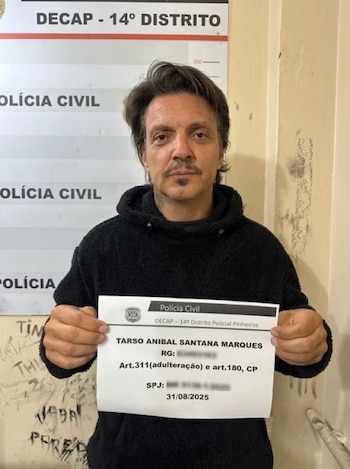
Tarso Marques is well-known among racing enthusiasts, especially since he participated in South American Formula 3 in 1993, the same year when a young driver named Fernando Croceri took the championship at the Buenos Aires Autodrome . Marques continued his career racing in Europe and eventually entered Formula 3000 (now known as Formula 2 ). He made his Formula 1 debut in 1996 with the Minardi team, which he also raced for in 1997 and 2001, notably sharing the cockpit with a then 20-year-old Fernando Alonso . Marques achieved his best results in Brazil and Canada , finishing ninth in both races—an achievement for a team typically competing at the back of the grid.
After his stint in F1, Marques also participated in Cart (currently IndyCar ) during 1999 and 2000 and was active in Stock Car races from 2006 to 2011, Brazil’s premier racing series. However, a controversy arose in 2011 when the magazine Warm Up revealed that Marques tested positive for anabolic steroid substances, leading to a two-year suspension from racing.
Even after stepping away from competitive racing, Marques remained a prominent figure in Brazilian media, frequently appearing on the Lata Velha segment of Caldeirão do Huck and Auto Esporte , both popular programs on Globo TV . He also runs a business dedicated to modifying cars and motorcycles, showing that his passion for automobiles extends beyond the racetrack.