
Like our mobiles or cars , airplanes turn to satellites to know where they are. These signals, integrated into the FMS management system (FMS) improve the precision and efficiency of aerial trajectories. Nevertheless, that system is not unique or infallible : In interference situations, pilots must resort to classical aid such as inertial systems, terrestrial radio aids, or even paper maps.
In times of war , these setbacks have become more common, especially in areas close to active conflicts. What was previously a rare incident is now a real concern for airlines , controllers, and governments. The recent flight of Ursula von der Leyen to Bulgaria has brought this issue back to the forefront, highlighting that even the most advanced systems can fail and that Europe is reinforcing its defenses to avoid such incidents.
When the GNSS System of a Plane Faces Issues
Many people commonly refer to satellite positioning as “GPS.” However, the technically accurate term is GNSS (Global Navigation Satellite System) , which integrates several constellations, including the American GPS , European Galileo , Russian Glonass , and Chinese Beidou . In aviation, modern receptors can combine signals from different networks to enhance reliability, allowing aircraft to plan more efficient routes and land accurately at airports where it was previously unthinkable.
The incident involving Ursula von der Leyen’s plane serves as an example of what occurs when this network fails. The European Commission confirmed that its flight experienced a disruption of the satellite signal on August 31, 2025, as it approached Plovdiv, Bulgaria. According to Reuters and the Financial Times , the pilots completed the landing using printed letters and traditional navigation procedures. Bulgaria stated that “the satellite signal transmitting information to the GNSS system of the plane was neutralized.” The commission later added that there is suspected “flagrant interference” by Russia ; however, Moscow denies this accusation.
If you have ever wondered how a plane continues flying when GNSS is lost, the answer lies in redundancy . In addition to satellite signals, planes have inertial systems that utilize accelerometers and gyroscopes to calculate their position, along with terrestrial radio aids. In Europe, the Galileo network operates with Egnos , a system that corrects errors and enables precise operations. This technological framework complicates flight but also reduces risk scenarios.
When we mention “interferences,” we refer to two primary techniques: jamming , which blocks the signals, and spoofing , which introduces false information to deceive the receiver. For pilots, both occurrences can translate into workload increases and alter the flying experience. Although Von der Leyen’s flight concluded safely, the event served as a stark reminder: the skies have become increasingly complex due to these aerial threats.
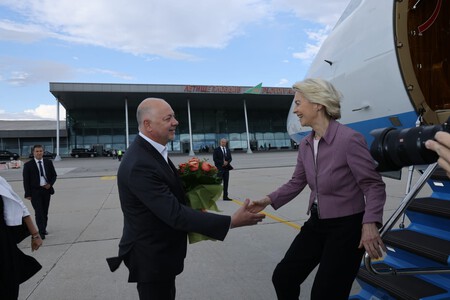
The President of the European Commission greets Bulgarian Prime Minister Rossen Jeliazkov upon arrival in Plovdiv, on a trip marked by an incident of jamming satellite signals
A notable incident occurred in March 2024 when the Royal Air Force plane transporting the then Secretary of Defense of the United Kingdom, Grant Shapps, experienced interference for several minutes while flying near the Russian enclave of Kaliningrad . According to British government sources cited by Reuters, the pilots had to use alternative navigation methods. The Kremlin did not comment on the event, but it was interpreted by the West as a demonstration of Russia’s electronic warfare capabilities.
Bulgaria and the European Commission point to Russia as a possible source of the interference experienced by the Dassault Falcon 900lx (registration oo-gpe) that transported Ursula von der Leyen, operated by Luxaviation Belgium . The aircraft was on a charter flight, as community institutions do not have an official fleet, and there is no conclusive evidence to confirm it was a deliberate attack against the plane. Moscow has denied any involvement.
The aircraft was a charter flight, as community institutions do not have their own official fleet.
How dangerous is it to lose the GNSS signal mid-flight? While redundant systems and emergency procedures drastically reduce the likelihood of an accident, they do not completely eliminate concern. The European Union Aviation Safety Agency (EASA) has warned that GNSS interference can degrade communication, navigation, and supervision functions, potentially causing false Terrain Awareness and Warning System (TAWS) alerts, which warn the crew about the risk of collision with land or obstacles. Each additional alarm in the cabin increases workload for the crew, requiring rapid reactions to maintain flight safety.
According to Airbus , when the GNSS signal is lost, an aircraft retains its primary navigation capabilities. The Flight Management System (FMS) compensates for the loss using data from other sources, such as inertial reference systems (IRS) and terrestrial aids (VOR/DME), thereby maintaining precise position calculations. However, high-precision navigation and surveillance functions that rely solely on GNSS may be temporarily affected until the signal is restored.
Institutional responses are also evolving. The European Commissioner of Defense , Andrius Kubilius, announced that the European Union plans to enhance its satellite network in low orbit to improve interference detection, although detailed timelines and operational specifics remain undefined. The Galileo network already offers OSNMA , an operational service since July 24, 2025, authenticating navigation messages and aiding in identifying and mitigating spoofing attempts.
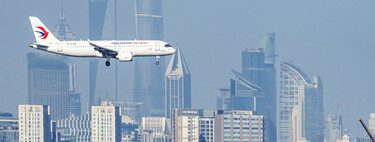
Ursula von der Leyen’s plane landed without serious incidents, but the message is clear: without satellite navigation, modern aviation loses a critical component. Europe is actively working to reinforce this infrastructure, both technologically and defensively, with the aim of ensuring that the events in Bulgaria represent an isolated incident in a broader technological conflict already taking place in space and cyberspace. The specifics of these measures are yet to be determined.
Images | Dassault Aviation | Rossen Jeliazkov
In Xataka | For years the Airbus A380 symbolized European power against Boeing. Today it survives as a colossus without a kingdom.