

In just over 40 days , Windows 10 will cease receiving patches and security updates. This marks the end of support for an operating system that still dominates nearly half of the global market . As noted in statistics, Windows 10 holds a remarkable 54% market share in Spain. Although Windows 11 has been available for several years, the transition has been slower than anticipated. The countdown is ticking , and millions of users seem to be hesitating about how to navigate this shift as the deadline approaches. Those willing to cover expenses may opt for extended support , allowing them to benefit from additional security measures.
What Real Options Now Exist for Standard Users?
The end of support doesn’t mean that your computer will suddenly stop working, but it will leave it more vulnerable. Microsoft offers three primary routes for users:
- Make the leap to Windows 11. If your hardware meets the necessary requirements, the update is free and guarantees continued updates and new features. Users with incompatible hardware will need to consider upgrading their devices to stay secure.
- Pay for extended updates (ESU). This option provides security patches for a fee, allowing users to continue operating on Windows 10. However, this plan is intended as a temporary solution rather than a permanent fix.
- Continue using Windows 10 or explore alternatives. Users might consider installing Linux or maintaining Windows 10 in a controlled environment. However, this pathway requires an understanding of the associated risks and careful planning for the future.
To evaluate the situation of Windows 11 compared to its predecessors, it’s useful to consider the adoption rates. According to Statista, at nearly three years and ten months in existence, Windows 11 occupies roughly 49% of the global market. In comparison, Windows 10 reached around 57% by the same stage, while Windows 7 had a notable 61% . Conversely, Windows 8.1 barely managed 10% , reflecting its poor reception.
This data illustrates a clear trend: Windows 11 is progressing at a slower adoption rate than its successful predecessors, yet it is still outpacing Windows 10. An essential factor behind this slow transition is the hardware requirements , which leave millions of older computers that ran Windows 10 effortlessly without support. For many, transitioning to the new version means investing in new equipment, which significantly impedes the migration process. Some unofficial methods enable installation of Windows 11 on incompatible PCs, but these come with risks, leading to a slower adoption rate and an enduring presence of Windows 10 as it approaches its end of life.
The slow uptake of Windows 11 is primarily linked to stringent installation requirements like TPM 2.0 and a closed list of processors, effectively excluding millions of older but still competent devices. For numerous users, the necessity to buy new hardware further complicates the move to the new operating system, hence the observed lag in adoption. Current statistics reveal a Windows 10 landscape that remains vibrant as support ends.
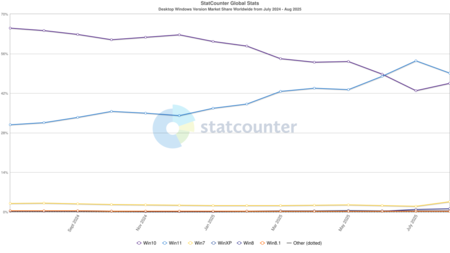
Microsoft Operating Systems Market Share Globally
In Europe and specifically in Spain, the transition rate occurs at a different pace . While the global average reflects that Windows 11 is nearing 50% of installations, Windows 10 still commands over 53% of the European market. In Spain, the figures are closely aligned (54% for Windows 10 and 42.61% for Windows 11). This divergence presents a different scenario where the upgrade to the new version progresses slowly , and Windows 10 remains the leading system as its support termination date approaches.
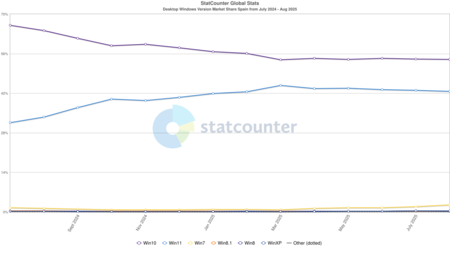
Microsoft Operating Systems Market Share in Spain
The reluctance to update is not unique to this generation of Windows. For instance, Windows 7 reached its end of support in January 2020 while still holding about 27% of the global market share, long surpassed by Windows 10. The current landscape, however, illustrates a starkly different picture: while Windows 11 holds a leading position, Windows 10 still accounts for nearly half of all installations just over a month away from losing official support.
Images | Microsoft
In Xataka | If you have an old PC, there is an effective alternative against the requirements of Windows 11 and the Bloatware: Flyoobe works