
For several weeks, I have been testing the Netatmo Weather Station in my office—a compact ten square meter cubicle where my workday unfolds. Situated in August in Valencia , the weather is often merciless, with temperatures hitting 35 degrees Celsius and humidity levels soaring to 75% at noon. However, my primary concern was not merely the temperature or humidity; my main focus was on monitoring the CO2 concentration .
The first Monday of testing began with curiosity. At 8:05 a.m., with the window and door left open since Friday, the sensor registered 438 ppm , which corresponds to atmospheric levels. As I settled into work, I noted the readings at 9:30 a.m. showed 455 ppm , indicating a minimal increase. Soon after, I closed both door and window to simulate winter conditions.
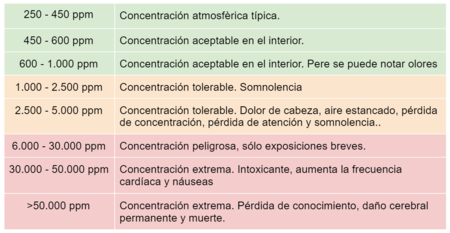
Effects of CO2 concentration on the environment. Image: Vobu.
After thirty minutes, the level climbed to 802 ppm . An hour later, it reached nearly 1,400 ppm , and shortly after, it soared beyond 1,600 ppm . At this point, I began to feel that characteristic mental fatigue —a heaviness I had previously attributed to mundane tiredness. It became clear to me that the inability to perform routine tasks well was intertwined with apathy . This wasn’t just a placebo effect; extensive research supports this assertion. According to a study from 2015 by Harvard and Syracuse , CO2 levels between 1,000 and 2,500 ppm reduce productivity in complex cognitive tasks by as much as 15%, and decision-making capabilities can decline by up to 23% .
Fearing increased CO2 levels, I reopened the window while keeping the door shut. Remarkably, the CO2 concentration dropped from 1,600 ppm to 800 ppm in just 25 minutes . The following day, by ensuring cross ventilation, I witnessed the same drop in merely 12 minutes —a difference I had not anticipated. Eventually, the level returned to 450 ppm .
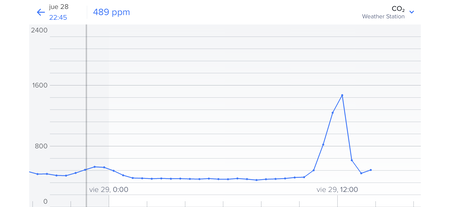
Graph of the Netatmo application during one of the tests, showing CO2 level fluctuations. Image: Xataka.
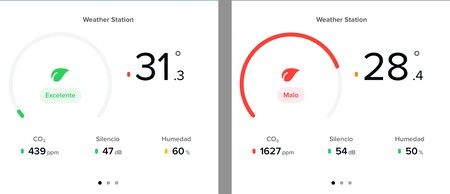
Interface of the Netatmo app displaying CO2 concentration alongside other metrics. Image: Xataka.
The Netatmo device carries an error margin of ± 100 ppm up to 1,000 ppm , and ± 10% beyond that. While not laboratory-grade precision, it serves well for gaining insights about your indoor air quality. The essential takeaway isn’t merely the exact number; it’s the trend and how it correlates with your well-being.
As days wore on, I noted distinct patterns emerging. More frequent ventilation was correlated with reduced mental fog and apathy—conclusions I had ample empirical evidence to support.
This leads me to consider the role of air conditioning . I initially assumed air conditioning might improve CO2 concentration; however, I soon discovered it primarily circulates air without freshening it. Air purifiers would only be effective if they draw in external air, as they filter particles but cannot eliminate gases like carbon dioxide.
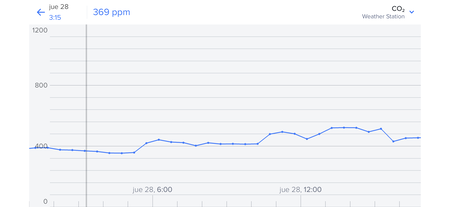
A closer look at the CO2 levels in varying conditions of air circulation and human presence. Image: Xataka.
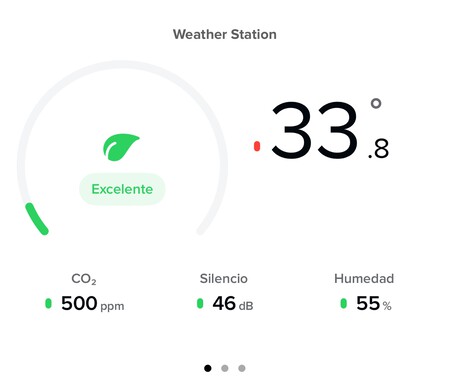
Image demonstrating the effects of CO2 on sleep quality. Image: Xataka.
I tested the device in the bedroom next. With two people asleep, the CO2 concentration escalated from 450 ppm to 1,100 ppm with a closed window and an open door. This resulted in a heavy awakening, leaving us feeling unrested. The following night, keeping the window open, the maximum level was 640 ppm , and I woke up feeling remarkably refreshed. The test convinced me to leave the windows open even during the winter months.
The station can measure various factors: internal and external temperature (with an additional module), humidity, barometric pressure, and noise levels. It is also expandable to include a rain gauge and an anemometer. The app is elegantly designed, featuring indefinite historical data and seamless integration with HomeKit . However, for those living in vertical spaces without gardens, the real value of this device lies in its CO2 monitoring capabilities .
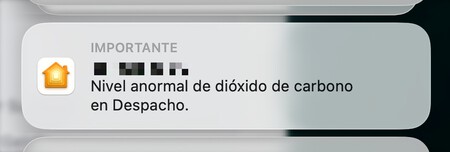
Notification from the Netatmo app regarding CO2 levels on Mac. Image: Xataka.

iPhone notification from the Netatmo app. Image: Xataka.
This experience has illuminated the fact that working with CO2 levels exceeding 1,000 ppm results in operating at merely 70% cognitive capacity . The complexity lies in the delayed awareness of these declines—a sensation akin to consuming an extra cup of coffee that initially seems harmless, yet accumulative consequences reveal otherwise. I now understand the need for maintaining open windows or, when weather does not permit, ensuring more frequent airflow than in the past.
Does this newfound awareness justify the price of 110 euros for the Netatmo Weather Station? Absolutely, if you work in closed environments. The value lies not in the device itself but in the awareness it cultivates . Previously, I would only ventilate when I felt the atmosphere “heavy.” Now, I recognize that feeling as a sign I have already been underperforming for an extended period. It’s akin to driving without a speedometer—you may think you’re doing fine until a glance reveals you’re going too fast.
The paradox here is that after three weeks of use, the Netatmo has taught me to listen to my body’s cues without needing the device. I’ve learned to identify subtle signs like slight ocular heaviness or a dip in verbal fluency. Yet, without the sensor’s objective data , this sensitivity would never have developed.
Consider it akin to refining a musical instrument: you initially need a tuner, but eventually, your ear learns to detect dissonances independently.
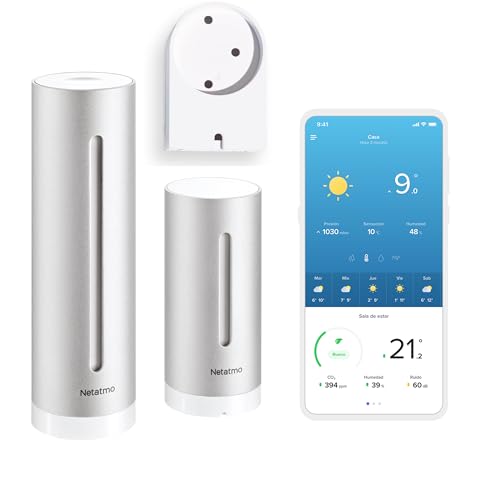
Netatmo Wifi Interior Wireless Meteorological Station, with thermometer, hygrometer, soundometer, and air quality monitor, compatible with Amazon Alexa, Apple, and Google.
Outstanding image | Xataka
In Xataka Science | Can you run out of oxygen if you get into a small room with many people?
This device was sent to me for testing by Netatmo. For more information, please refer to our review policies on Xataka.