
Microsoft’s AI Frontier: A Shift from Partnership to Competition
Since the fever broke out over generative AI, Microsoft has opted for OpenAI models to give life to key functions in some of its most important products. It is no surprise, considering that those in Redmond invested over $10 billion in the startup led by Sam Altman. However, this strategic alliance has been showing visible fissures for months, and as time passes, the rivalry between both parties becomes increasingly evident.
It was Microsoft itself that, a year ago, included OpenAI in its list of competitors alongside giants like Amazon, Apple, Google, and Meta. According to The Information, OpenAI insists on not wanting to share its cutting-edge technology when (or if) artificial general intelligence (AGI) arrives. Despite attempts to bolster the partnership, the bond is no longer as solid as it was during its inception. Now, there’s another chapter underway.
Microsoft AI Begins to Show Their Own Cards
Mustafa Suleyman, CEO of Microsoft AI, who took the helm when the partnership with OpenAI was solidified, recently presented two internally developed models. These advanced solutions reflect the company’s ambition to “create AI applied as a platform for products.” One model is entirely new, while the other is an iteration of existing technology. Here are the details.
Mai-1-Preview is the standout model. This mixture-of-experts model, similar to GPT-4O or GPT-5, is designed to excel in task execution and offer practical solutions for everyday inquiries. Suleyman asserts that it’s the first model trained entirely in Microsoft AI’s laboratories.
The most compelling aspect is that it can be tested immediately. Users can visit LMARENA, select “Direct Chat,” and choose Mai-1-Preview. In the upcoming weeks, it will also feature in Copilot, albeit for “specific cases of text use.” Paradoxically, while the text functions of the Microsoft Chatbot are powered by OpenAI, it will soon coexist with its own technology. Developers can also request anticipated access to the API.
MAI-VOICE-1 is a voice generation model distinguished by its expressiveness and naturalness. This technology has been implemented in features like Copilot Daily (news summaries) and Copilot Podcasts, although currently only in English. It is also available in COPILOT LABS, where users can experience various voices, styles, and narration tones.
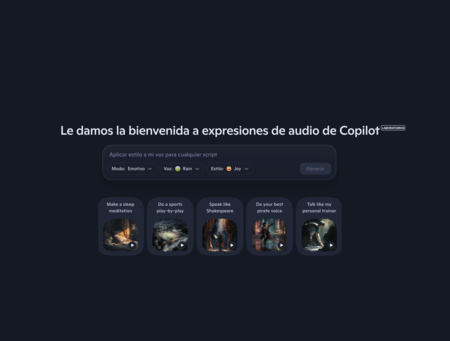
One of its notable advantages is efficiency; it can generate a full minute of audio in under a second using a single GPU, making it one of the fastest voice systems currently available.
Microsoft argues that voice will be the future interface for AI assistants. The company aims to advance with a high-fidelity solution capable of responding to various scenarios. Could they have utilized OpenAI and its GPT-4O in an audio format? Yes, but indications suggest they prefer to forgo that option.

“Much more to come. We have great ambitions for what is next: advancements in models, an exciting roadmap for computational capacity, and the opportunity to reach billions of people through Microsoft products. We are building an AI for all,” Suleyman declared on X.
Ultimately, it remains to be seen how the relationship between Microsoft and OpenAI will evolve. What is clear for users is that they can anticipate a broader variety of tools and technologies to explore.
Images | OpenAI
In Xataka | Goal wants us to use AI when we don’t know what to say on WhatsApp: Here’s how your new writing assistance option works.