
Climate Change as Explored Through the Unique Cases of Antarctica and Greenland
Antarctica and Greenland have emerged as two of the most crucial indicators of climate change . The dramatic loss of ice in Greenland has been closely monitored for several years due to its far-reaching impacts—not only on rising sea levels but also on the sinking of the seabed beneath it. Recent studies suggest that Greenland’s glaciers have passed a critical point from which they cannot recover. Insights from a recent NASA study reveal an unexpected beneficiary of the thaw: phytoplankton .
This revelation, however, does not offer good news for the environmental balance.
Firstly, it was recently reported that Greenland is experiencing increasing greening effects. Over the last 30 years, estimates suggest that the region has lost about 1.6% of its ice—an amount equivalent to the total land area of Galicia . The average air temperature has risen by approximately 3 degrees Celsius between the years 2007 and 2012 compared to historical figures from 1979 to 2000. Notably, this thaw is leading to a significant increase in fresh water entering the seas.
How much water, exactly? According to research conducted by San José State University and NASA, Greenland is discharging up to 266 million tons of fresh water per year into the ocean, predominantly beneath the Jakobshavn glacier , the largest glacier in Greenland. This translates to an astonishing 1,200 cubic meters of fresh water being released into the ocean every second. Because fresh water is less dense than saltwater, it creates a whirlpool effect, pulling nutrients from the seabed up to the surface.
The Study. The nutrients being drawn to the surface include vital components such as iron and nitrates , which are great for phytoplankton. However, this phenomenon raises concerns about how rapid phytoplankton growth might impact the ecosystem. In a study published in “Nature,” researchers utilized a specialized model developed by JPL and MIT to simulate interactions among thaw water, nutrients, and phytoplankton.
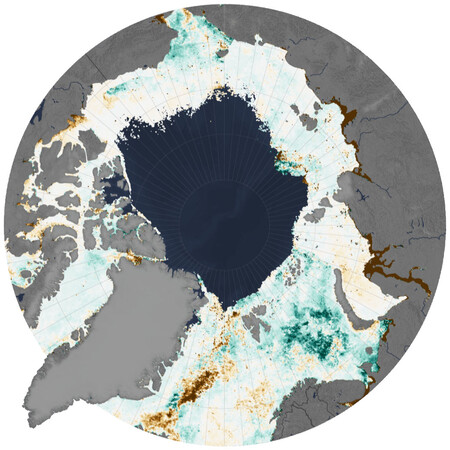
The greatest areas is where an increase in chlorophyll has been seen in recent years
Findings indicated that phytoplankton growth in the assessed area surges by 15% to 40% during the summer months, coinciding with peak thaw periods, thanks to the nutrients transported to the surface. Between 1998 and 2018, NASA observed a 57% increase in phytoplankton growth in Arctic waters.
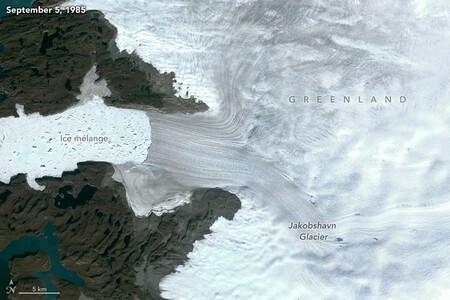
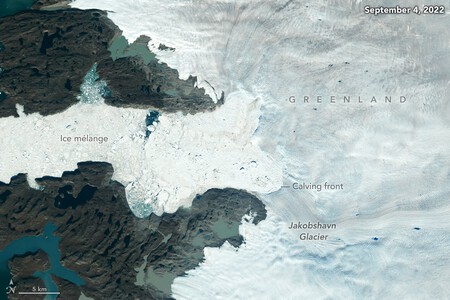
Consequences. The surge in phytoplankton can be beneficial for marine life, acting as a more substantial base for the food chain, nurtured by photosynthesis. However, shifts in temperature, chemical composition, and salinity could disrupt existing ecosystems. While the study refrains from making predictions, it’s clear that significant changes in marine properties are taking shape. These alterations risk modifying the food chain, which can have dramatic effects on marine species—from microorganisms to larger fish—imbalance that can significantly affect fishing activities vital to Greenland’s economy.
Phytoplankton, while microscopic, forms the foundation of a food web sustaining vital species, including krill, which in turn support larger animals such as whales and fish.
This Is Not Unique to Greenland. Even though the study focused specifically on the Jakobshavn glacier , similar dynamics may arise in the more than 250 marine glaciers present in the region, and potentially extend to other glacial systems worldwide. Researchers acknowledge that this simulation technique could be adapted to other landscapes, suggesting it is likely that other areas experiencing glacial melting are also witnessing significant changes, with potentially severe implications for regional ecosystems and fishing endeavors.
As a result, the ramifications of glacial thawing extend beyond sea level rise ; they could also disrupt the ecological balance in various regions worldwide. As the old adage goes, “when it rains, it pours,” and this situation exemplifies that reality, revealing how interconnected our environments truly are.
Images | POT
In Xataka | 400,000 years ago all Greenland ice melted. The map he drew is not flattering