

The Emerging AI Bubble: Lessons from the Past
The conversation around Artificial Intelligence (AI) has taken a dramatic turn lately, with industry leaders expressing growing concerns about the potential for an AI bubble . While some, like Sam Altman, CEO of OpenAI, acknowledge the excitement surrounding AI, they also caution against potential overvaluation, reminiscent of the Dot-com bubble of the late 1990s and early 2000s.
What Has Altman Said?
During a recent roundtable with journalists marking the launch of GPT-5, Altman made several provocative statements :
“When bubbles occur, intelligent people are excessively excited about what is, in fact, just a pinch of truth.”
“Are we in a phase in which investors are too excited about AI? My opinion is that yes.”
“Is AI the most important thing that has happened in a long time? My opinion is also yes.”
Altman’s comments echo the anxieties of many analysts who have warned about a potential AI bubble that may be even larger than the dot-com crash.
Reflecting on the Dot-Com Era
Altman compares today’s dynamics with those of the late ’90s, when the Nasdaq lost roughly 80% of its value between March 2000 and October 2002. Many companies that were deemed “revolutionary” during the Internet boom failed to convert excitement into actual revenues, leading to significant financial fallout.
The value of the highest-performing companies in the S&P 500 is significantly greater today than in the late 90s, suggesting a potential bubble. Source: Apollo Global Management / Tornsten Slok.
The Potential for Greater Crisis
Economic experts, including Torsten Sløk , chief economist at Apollo Global Management, claim that today’s AI bubble could be worse than the dot-com crisis. The top ten companies in the S&P 500 now hold a value far greater than those in the late 1990s. Furthermore, they warn of the danger of excessive speculation , echoing sentiments that are becoming increasingly prevalent in discussions around the AI market.

The Dual Nature of AI Investment
Ray Wang, director of the Futurum Group, presents a dichotomy in AI investment. He acknowledges that while the broader AI and semiconductor investment landscape appears robust, there is too much speculation surrounding many companies lacking solid fundamentals. As he notes, many investors are drawn to companies based on hype rather than substance. This adds to the fears of bubble formation , as companies with unrealistic promises attract ungrounded valuations.
The Inevitable Cycles of Innovation
Some experts, like Alberto Romero, suggest that bubbles are often a necessary evil in the evolution of technologies. They act as a bridge between short-term speculation and long-term advancement. Romero believes that such hype can lead to valuable technological breakthroughs, even if many companies crash on the way.
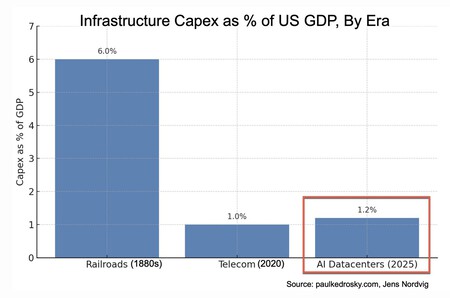
Source: Paul Kedrosky.
Historical Parallels with Transportation
Romero parallels the current AI landscape with the railroad boom in the 19th century. Despite numerous failures, the massive investments led to substantial advances in both transportation and social infrastructure. This raises an important question: could the AI hype ultimately lead to transformative progress, despite the proliferation of companies that may not survive?
Current Trends and Future Predictions
Today, data centers are absorbing significant resources, pouring money into infrastructure that may or may not pay off. Additionally, the concentration of wealth and success within a few dominant companies raises ethical and economic concerns about market sustainability.
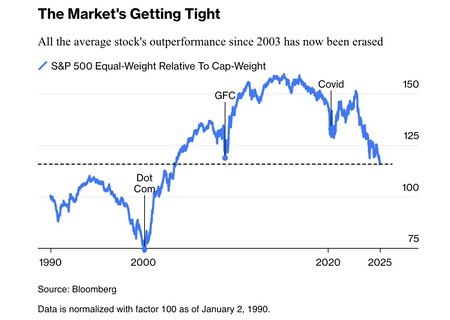
Source: Bloomberg.
If the AI bubble bursts, Robin Li, CEO of Baidu, warns that only 1% of companies may endure the fallout, similar to past technology booms. This signals that while the enthusiasm for AI can lead to innovation, it is crucial to temper expectations and ensure grounded assessments of potential growth. AI is positioned to bring significant value; however, whether that value will be broadly shared or concentrated in a few companies remains uncertain.