
Even the most experts in technology can fall victim to online scams. One such case is that of Alex Rivlin, a real estate agent from Las Vegas , who unknowingly became a target of a new and sophisticated scam. His case, uncovered by The Washington Post, raises alarms about how emerging generative artificial intelligence (AI) tools, such as Google’s summaries , are being exploited to breathe new life into old deceptions.
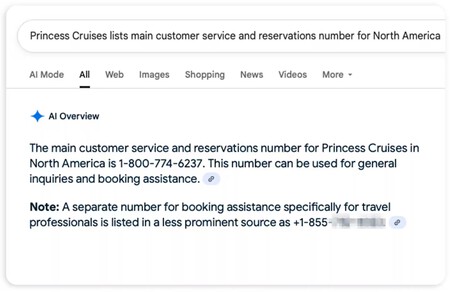
A Scam That Began with a Simple Task. Alex was searching for a transport service to book for a European cruise. While looking for Royal Caribbean’s customer service number on Google, he was provided with a phone number directly in the search results. Unbeknownst to him, this number did not belong to the shipping company but rather to a group of scammers.
A Perfectly Orchestrated Hoax. Once Alex dialed the number suggested by AI, an alleged customer service representative answered, offering precise details about his transport in Venice . The operator quoted rates and even negotiated the possibility of waiving some service fees that were included in the company’s service portfolio.
Ultimately, they settled on a charge of $768 . To facilitate the payment, Alex provided his credit card information.
</div>The Scam Was Uncovered the Next Day. Alex noticed suspicious transactions on his bank account, and upon further investigation, realized that the name associated with the charges was not Royal Caribbean . This prompted him to understand he had been deceived. Thankfully, he managed to cancel his credit card, and his bank reimbursed him, although he was stunned by the sheer ingenuity of the scam.
Old Tricks, New and Powerful Ammunition: AI. The incident involving Rivlin is not an isolated case but rather the tip of the iceberg of a growing issue. The tactic of publishing false customer service numbers is not new; however, the advent of generative AI has escalated its effectiveness.
Historically, scammers paid to have their numbers appear among the first search results. Now, with AI, they can thrive even more effectively. This technology pulls data from across the web but often does not verify its authenticity. Consequently, if a phone number appears multiple times on various websites and forums, AI might mistakenly interpret it as credible and present it to users seeking assistance.

Moreover, The Washington Post’s investigation revealed that the same fraudulent phone number was linked to major cruise lines, including Disney .
The Technology Response and Experts’ Criticism. Google has stated to The Washington Post that its AI summaries and search results are generally effective in directing users to official information and that specific fraudulent examples have been removed. However, many critics argue that this is insufficient.
Lily Ray, Vice President of SEO strategy at Amsive Digital Marketing , emphasizes that allowing AI summaries to provide phone numbers “opens a new avenue for scammers, and one they are clearly taking advantage of.” Security experts have pointed out that Google already possesses verified commercial information databases that could be prioritized rather than relying on broader web content vulnerable to manipulation.
Overlooking AI’s Flaws is Not Wise. This situation illustrates how hackers will always find ways to compromise our data. They take advantage of the trust we place in Google’s AI results, as it often serves as the first point of contact. Similar issues were seen with search results found through Google Ads, raising concerns over the long-standing belief that “if it appears on the first page of Google, it’s trustworthy.”
Therefore, the guidance is clear: Always verify any information, especially phone numbers, through official sources such as the company’s website or app.
More AI-Related Scams Exist. This example isn’t isolated; studies have shown that when users ask an AI about a company, inaccuracies can occur, opening doors to phishing attempts. Scams may also extend to areas like Spotify playlists or seemingly innocuous PDF files.
Image credits | Firmbee.com | Nordwood Themes
In conclusion, it is evident that as technology progresses, so do the methods used by scammers. Awareness and diligence are now more crucial than ever to protect oneself from potential fraud.