
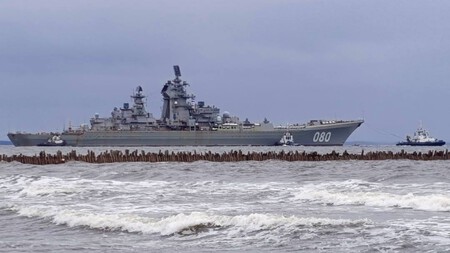
Russia has returned to the sea with its largest nuclear cruise ship for the first time since 1997. The *Admiral Nakhimov* began trial runs on August 18, 2025, in the White Sea , marking a significant milestone for a modernization program that has faced numerous delays over the years. According to Tass, the ship’s two nuclear reactors were reactivated in early 2025, allowing it to move under its own power again. However, the re-emergence of this 28,000-ton vessel raises critical questions about the extent of modernization achieved by Moscow.
The *Admiral Nakhimov* has a complicated recent history characterized by repeated delays. Although the modernization process was initiated more than two decades ago, The War Zone notes that actual work on the ship didn’t commence until 2014. Since then, target completion dates have continuously shifted: from 2018 to 2020, then to 2021 and 2023. While the ship’s return to sea is a tangible achievement, it also signifies the end of a prolonged cycle of unfulfilled promises that now need to be realized through demonstrable capabilities.
What Has Really Modernized and What Remains in the Air
The return of the *Admiral Nakhimov* unfolds amidst a backdrop of scant information about the ship, raising multiple questions about its current capabilities. Initial reports suggest that the vessel has received at least a new radar system and a modernized main gun (the Caño AK-192m ).
The modernization aimed to position the *Admiral Nakhimov* as the ship with the most vertical launch systems in the world, boasting a total of 174 missile cells —78 for attack missiles (Kalibr, Oniks, Zircon) and 96 dedicated to S-300FM air defense systems. At present, only the newly installed main cannon has been conclusively documented; the rest remains to be validated through operational tests, official images, and documentation.
Its return to service is more than a mere technical undertaking; it’s largely symbolic . It is anticipated that the *Admiral Nakhimov* will take on the role of flagship for the northern fleet once complete trials are conducted and the ship is formally accepted by the Navy. This would replace the aging *Pyotr Velikiy*, another nuclear-powered cruiser built during the Soviet era, which launched in 1996 but has only undergone minimal updates.
Meanwhile, the *Kuznetsov* aircraft carrier remains in a precarious state. According to statements reported by Reuters, the president of the State Naval Construction Corporation indicated that the carrier is likely to be either scrapped or sold, which would further enhance the *Admiral Nakhimov*’s prominence in the Russian naval hierarchy.

The *Admiral Nakhimov* still has much to prove. Just because it has navigated again does not imply that the modernization is complete or fully operational. The actual status of its sensors, combat systems, data links, and integration with other naval assets remains unverified. Beyond the official narrative, the ship’s operational activity will determine if this resurgence signifies a new era or if it is merely a maneuver with limited impact.
Images | RSS_40
In Xataka | Ukraine has entered a phase so deranged with the drones that his drones are knocking themselves to themselves