
Cayo Apuleyo Diocles: The Wealthiest Athlete of Ancient Rome
Current sports figures such as Lionel Messi , Cristiano Ronaldo , Rafael Nadal , and Fernando Alonso are celebrated for their extraordinary skills and accomplishments in their respective sports. These athletes, alongside their clubs and sponsors, are rewarded handsomely for their performances. However, when we delve into the annals of history, none of these modern-day titans would stand a chance against the wealth accumulated by the most famous athlete of ancient Rome: Cayo Apuleyo Diocles .
When reminiscing about the Roman Empire , it’s crucial to remember that the quadriga races were among the most popular spectacles of the time. Picture them as the ancient equivalent of a Formula 1 Grand Prix . Instead of roaring engines, these races featured quadrigas pulled by four horses , trigas with three , and bigos with two , all competing in factions like the Whites , Reds , Blues , and Greens .
In many ways, these racing chariots can be likened to today’s high-speed automobiles, and the drivers , or aurigas , were revered much like modern-day superstars. Unlike today’s athletes, these Roman charioteers didn’t enjoy exclusive sponsorship agreements, but they earned vast fortunes based on their race victories.
Cayo Apuleyo Diocles stands out as one of the most successful aurigas in Roman history, celebrating victory in an astounding 1,462 races . Each victory not only earned him the laurel crown but also substantial monetary rewards. His exceptional career made him one of the best-paid athletes of his era, accumulating a wealth greater than any contemporary athlete when adjusted for inflation.
From Humble Beginnings to Greatness
Despite his renowned status, the legacy of Cayo Apuleyo Diocles survives through scant historical records. The most significant piece of information is a tombstone placed in his honor that experts believe adorned the walls of the Nero Circus , located in what is now Vatican City. This stone pays tribute to Diocles and details the considerable sums he earned throughout his racing career.
Born in Lusitania , a region corresponding to modern-day Portugal , Extremadura , and southern Castilla y León , it’s presumed that he hailed from the capital, Augusta Emerita (now Mérida ). However, no written records confirm this.
Historians believe Diocles was born in 104 AD , with his racing debut occurring at the tender age of 18 . Just two years into his career, he began to collect accolades, raising champion laurels one after another.
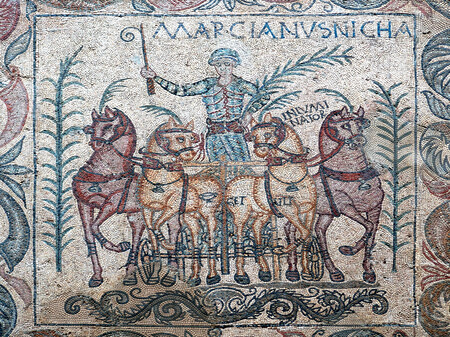
Roman Auriga
For the next 24 years , Diocles electrified audiences with his performances at some of the most prestigious venues, like the Maximus Circus in Rome, which could host up to 150,000 spectators . To add drama and spectacle, he sometimes requested to start from the last position, only to surge ahead and claim victory.
Records indicate that more than just his driving skills set him apart. Diocles retired at the age of 42 years, 7 months, and 23 days , amassing one of the longest careers in a perilous sport.
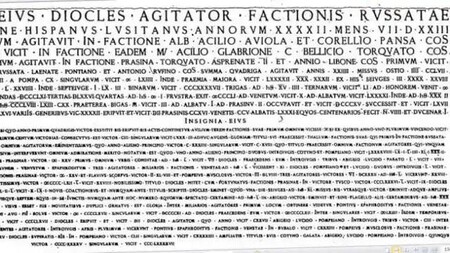
Transcription of the wake of Cayo Apuleyo Diocles found in the Nero Circus
Chariot racing was perilous; collisions were common, leading to aurigas being trampled or thrown from their chariots. This danger resonates with the fierce competition seen in modern motorsport.
Diocles’ impressive racing tally includes 4,257 races , with an astounding 1,462 victories and finishing second in 1,438 events. His prowess extended beyond standard competition, as he also triumphed in races featuring chariots pulled by up to seven horses .
Among the most notable feats recorded was his participation in two races on the same day, where he claimed victories in both—a testament to his extraordinary skill.
Professor Peter Struck from the University of Pennsylvania has estimated that Diocles amassed around 36 million sestertii . When adjusted for inflation, this fortune is equivalent to an astonishing $15 billion , placing him among the top 100 wealthiest people globally, as per the Forbes list .
Cayo Apuleyo Diocles spent his retirement in comfort in Praeneste (modern-day Palestrina ), where tablets found in a temple mentioned his children, Cayo Apuleyo Nimfidiano and Nimfidia . As one of the richest athletes in history, his legacy continues to inspire as a monument to ancient sportsmanship and success.
The astonishing career of Cayo Apuleyo Diocles illustrates not only the historical significance of chariot racing but also how athletic achievement can transcend time and cultural boundaries. His wealth and enduring fame serve as a fascinating reminder of the power and allure of sport, both in ancient Rome and today.