
Duolingo’s Stock Market Rollercoaster: A Cautionary Tale
Duolingo is currently facing a significant setback in the stock market. In early June, its stock price hovered around $525 , but has since plunged to $325 , marking a staggering 38% decline . While the exact reasons for this collapse remain fuzzy, one element stands out: Artificial Intelligence (AI) .
Be careful what you say. Just three months ago, Luis von Ahn, CEO of Duolingo, made controversial statements regarding the integration of AI into the company. He suggested that some of Duolingo’s external collaborators could be replaced by generative AI systems . Despite emphasizing the company’s commitment to employee welfare, he indicated that AI’s role would expand significantly. The goal? To “eliminate bottlenecks so we can do more with our existing employees.”
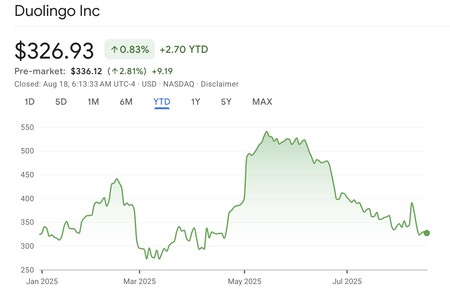
<span>The value of Duolingo's stock has experienced significant fluctuations, with a clear negative trend recently. Source: Google Finance.</span>Boom and drop in actions. Von Ahn’s comments initially caused a surge in stock prices, propelling them from $400 to $530 in just a few days—a remarkable 32.5% increase . However, investor optimism faded quickly. The stock price soon plummeted below its previous levels, now aligning with early-year figures.
It seemed that Duolingo traced a positive turn with its recent financial results, showcasing the success of its business model. The emphasis on gamification—making language learning feel more like a game rather than a chore—temporarily halted the stock’s decline. Although encouraging, this upward momentum soon proved insufficient.
GPT-5. The situation took another dramatic turn during the unveiling of OpenAI’s new model—GPT-5. A notable demonstration showcased an engineer quickly creating an interactive web application capable of teaching French in just three minutes. This development posed a direct challenge to Duolingo, providing users a free alternative to its paid application for learning languages.
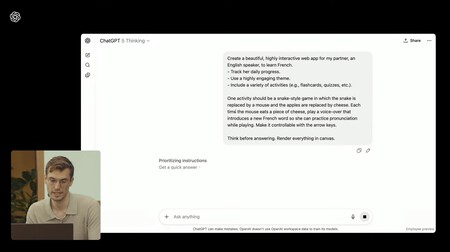
<span>This single PROMPT allowed GPT-5 to create an interactive website aimed at teaching French. Source: OpenAI.</span>Be careful with gamifying everything. While the ability of GPT-5 to act as a personalized teacher is fascinating, other factors may have also contributed to the volatility affecting Duolingo’s stock. The heavy focus on gamification in the language learning process comes with its own set of criticisms. Many argue that this approach may detract from genuine learning experiences. As one Reddit user pointed out, “for me, the reward for learning a language is to learn the language.” Others have noted that Duolingo feels less like a learning tool and more like a game with learning as a side effect.
The condemnation of advertising. Further criticisms are directed at the increased presence of advertisements in the free version of Duolingo. While the premium version offers an ad-free experience, the influx of ads has become an annoyance for many users. Although profitable, the strategy resembles streaming services that annoy users with relentless advertising.
Of betting on AI to be threatened by her. Ultimately, the decline in investor confidence may stem from broader concerns regarding companies’ commitments to AI. Firms that invest heavily in AI technologies are experiencing greater stock market success, but many remain cautious about the long-term impacts of these advancements.
AI as a private teacher. Regardless of the unpredictable fluctuations in stock prices, one thing is clear: AI has tremendous potential as an educator across various fields, not just languages. Demonstrations like those seen with GPT-4 showcase how AI could redefine traditional learning paradigms. As AI technology continues to evolve, platforms like Duolingo must reconsider their strategies for incorporating these advancements.
In summary, Duolingo’s current struggles are indicative of a larger trend within the tech educational sector. The intersection of AI development and gamification raises questions about the future of language learning and whether existing models can adapt or endure in this rapidly changing landscape.