
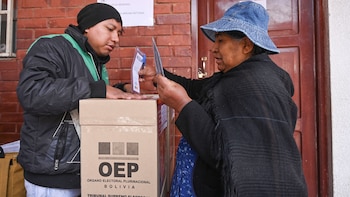
Bolivia celebrates this Sunday elections marked by uncertainty, with a high percentage of undecided voters and a backdrop of economic and political crisis .
For the first time in two decades, the left arrives divided, while the opponents Samuel Doria Medina of the Unit Alliance , and the former President Jorge “Tuto” Quiroga (2001-2002), freely head the surveys without a significant advantage to impose themselves in the first round. The leftist candidate with greater projection, Andrónico Rodríguez, has fallen to fifth place with merely a 5% intention to vote, reflecting the fragmentation of the official space .
The surveys also record a residual vote – white , null , and undecided – that exceeds 30% , surpassing any of the eight applicants, suggesting a highly competitive scenario.
In this framework, the former president Evo Morales has promoted an unprecedented campaign advocating for the null vote, as a response to his judicial disqualification from competing. “This choice is made to return the right and not the Bolivian people, a democracy without the people, without the deep Bolivia, without the indigenous movement, without the popular movement,” Morales exclaimed, calling his followers to mark a large X on the ballot.
According to the polls, the null vote reaches 14.6% . Although it will not be counted in the calculations, analysts believe it channels the position of Evism within the institutional framework. If the trend materializes, Bolivia could witness its first presidential ballot in history on October 19 .
Next, a minute-by-minute coverage of the election day:
The Supreme Electoral Court opens the day
At 07:15 – local time – the opening ceremony of the voting day began in Bolivia. The president in charge of the Supreme Electoral Court (TSE) , Óscar Hastenufel, officially opened the day with a message directed to all citizens.
“Today we will live a new chapter of our democratic history. Bolivians will go to the polls, and with the strength of their vote, they will decide who will conduct the destinies of our nation,” he stated.
According to the TSE’s representative, Gustavo Ávila, more than 3,000 international observers are in Bolivia to supervise the elections. “This is the most observed election in the history of Bolivia,” Ávila declared.
The representative explained that all electoral suitcases have already reached the country’s voting enclosures, ensuring the proper preparation for the electoral day. Ávila disclosed: “Electoral suitcases are in all enclosures; that is a first symptom of our preparedness. All our staff is deployed in all electoral enclosures.”
On measures to preserve the secrecy of the vote, Ávila clarified that the prohibition of cell phones at the time of voting responds to previous complaints received by the TSE and aims to protect each voter’s privacy.
For its part, Pedro Callisaya, representative of the Ombudsman , confirmed the arrival of seven international missions to monitor the electoral process, reinforcing the historical significance and observation level of this day in Bolivia.
The event took place in the gardens of the electoral entity’s building in La Paz, in an environment of expectation and active participation.
With this beginning, the electoral process is formally enabled for thousands of voters. Organization and security have been reinforced at key points according to the authorities.
The polls opened throughout the country at 8:00 AM , local time.
More than 7.5 million Bolivians are enabled to vote
A total of 7,567,207 citizens are enabled to vote this Sunday in Bolivia, choosing the president, vice president, and members of the Parliament for the next five-year period. Abroad, 369,308 Bolivians may only participate in selecting the presidential binomial, without the obligation to vote.
Voting is mandatory, and each voter will receive a necessary certificate to carry out public and banking procedures for the next 90 days .
The process features the system for the transmission of preliminary results (Sirepre) , tested in drills across the nine departmental courts, along with the presence of 14 international observation missions , including those from the European Union (EU) and the Organization of American States (OAS), in addition to five national delegations.
The parallel dollar in Bolivia remains stable in prelude to the elections
According to the specialized portal dollarboliviahoy.com, the currency is quoted at 13.55 Bolivians for purchase and 13.65 for sale, without showing significant variations compared to the previous week.
The Central Bank of Bolivia maintains the official exchange rate at 6.96 Bolivians per dollar, which intensifies the gap between both markets amidst a growing demand for currency.
Bolivians in Japan inaugurated the election day with the beginning of the vote abroad
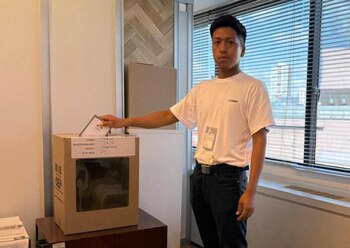
Due to the time difference, Bolivians residing in Tokyo, Japan were the first to cast their vote on Saturday night in the national elections. In that country, a total of 307 nationals are enabled to participate in the voting process, as reported by the TSE .
The first images of the suffrage were shared by the TSE around 20:00 (local time). “We began work in advance for the vote abroad. Japan is the first country that votes, and obviously is the first country that sends us the minutes,” explained TSE vocal Gustavo Ávila hours beforehand.
According to the court, the Plenary Chamber of the TSE aims to finalize the calculation of the vote abroad the same evening of the election day. The voting process outside of the country will occur in 22 nations, where 369,308 Bolivian citizens are enabled to exercise their right to vote.
The Bolivia government warned that Evo Morales sectors will try to “convulse and hinder” the election day of Sunday
Government Minister Roberto Ríos said there are “intelligence reports” that point to groups linked to the former president. “We cannot allow these people to attempt against security in our country,” he stated
A few hours before the elections, the Minister of Government, Roberto Ríos, issued a public warning regarding alleged attempts to “convulse and hinder the electoral process” on Sunday. Ríos indicated at a press conference that police authorities possess intelligence reports pointing to sectors linked to former president Evo Morales.
The OAS rejected any action that tries to hinder Sunday’s electoral process in Bolivia
Juan Fernando Cristo, Head of the Observation Mission of the Agency, urged “to act with responsibility for the present and the future” of the country
The Organization of American States (OAS) expressed its rejection of any action that intends to obstruct the electoral process of Bolivia, according to a message released Saturday on the agency’s social networks. Head of the observation mission, Juan Fernando Cristo, urged citizens to exercise their right to vote to strengthen democracy, emphasizing the importance of avoiding incidents that could compromise the transparency and tranquility of the day.
The Bolivia Supreme Electoral Court called on citizens to vote without cell phones in the midst of coercion complaints
TSE’s request comes after pressure on state officials to choose certain candidates and provide photographs as suffrage evidence for particular options
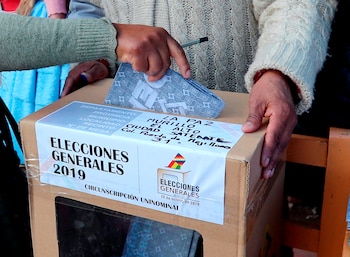
The electoral day occurring this Sunday in Bolivia is marked by an unusual call from the Supreme Electoral Court (TSE) , urging the population to avoid bringing mobile phones into voting enclosures.
Elections in Bolivia: Samuel Doria Medina’s party denounced that the Government plans to accuse the opposition candidate of fraud
The Unit Alliance, which leads the polls, rejected the “unacceptable interference” of the Executive in the electoral process and asked the Supreme Court to reject any attempt at official sabotage on Sunday’s elections
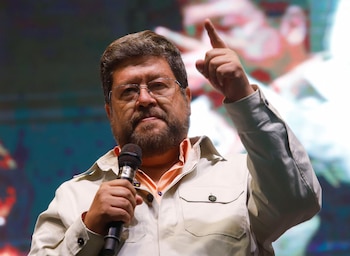
A few hours before the elections in Bolivia, political tension has escalated in the South American country following the allegations from the alliance Unit, which accused the government of Luis Arce of preparing a plan to hold them accountable for electoral fraud .