

DuckDuckGo: A Viable Alternative in the Era of AI and ‘Slop’
The internet is undergoing a profound transformation as artificial intelligence (AI) and user-generated ‘slop’ dominate the landscape. While AI has streamlined information retrieval, it has also led to a significant reduction in meaningful clicks —by almost half. The result is a troubling trajectory for traditional media. The increasing prevalence of low-quality, AI-generated content necessitates better filtering mechanisms. As users grapple with this issue, an old adversary of Google has resurfaced as a credible alternative: DuckDuckGo .
What is DuckDuckGo Doing Differently?
DuckDuckGo is a search engine that prioritizes user privacy . Unlike other search engines, it doesn’t track users or store personal information. As part of its mission, DuckDuckGo utilizes Bing’s search results. Recently, the platform marked its 16th year by launching a Filter for AI-generated images. This innovation aligns with its philosophy of providing services that are “private, useful, and optional.”
For the end user, this filtering capability offers a significant benefit: the option to view or hide images generated by AI. This feature addresses increasing concerns regarding distorted results , a problem extensively noted in Google’s image search . For instance, searches can yield bizarre or irrelevant images, such as distorted versions of well-known artworks. DuckDuckGo aims to mitigate these issues with their innovative filtering approach.
How Does DuckDuckGo Achieve This?
DuckDuckGo’s new filter doesn’t rely on AI; instead, it uses manual open-source blocklists that have been popularized by Ublock Origin and the HUGE AI Blocklist created by users seeking to manually filter out AI-generated content from their search results. This approach gives users a sense of autonomy over what they want to see.
Effectiveness and Limitations of the Filter
While DuckDuckGo’s filtering system is a step in the right direction, the company acknowledges its limitations. In a recent statement, they stated that the filter “will not capture 100% of the results generated by AI,” but they do anticipate that it will “considerably reduce” the volume of AI-generated images presented to users.
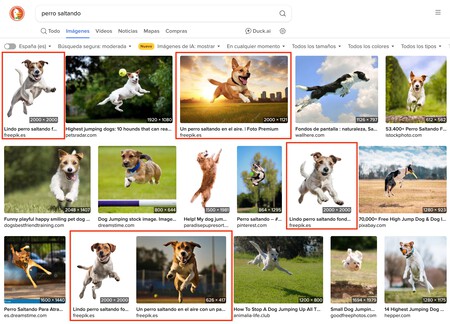
Examples of AI-generated images that may not appear when the filter is activated.
In our experiment, searching for “dog jumping” without the filter yielded an image from Freepik, which was later identified as AI-generated and stopped showing once the filter was activated. This instance demonstrates both the effectiveness of the filter and the challenge of identifying images with dubious origins.
The Challenge Ahead
While DuckDuckGo’s filter is impactful, challenges remain. For example, Freepik is a platform that already marks some images as “generated with AI.” However, what happens when a random image sourced from a media outlet lacks any label? To address this, advanced verification systems would be necessary, but they require substantial resources.
Beyond image filtering, DuckDuckGo faces the broader dilemma of identifying AI-generated text content . For instance, OpenAI once released a tool designed to detect plagiarism but later retracted it. While rumors suggest they are working on a new tool, there’s as yet no confirmed solution for effectively filtering AI-generated text.
The Ongoing Problem of Detection
Detection tools struggle with reliability. Many professors have mistakenly accused students of plagiarism, highlighting the issues of misidentification. Although Google is developing its Synthid watermarking technology to tag AI-generated content, the overarching issue remains: the lack of a universal standard for identifying AI-generated work.
Even if such a standard were established, not all users would be eager to label their AI creations. For instance, some images generated by Google still lack visible indicators, which leads to further complications in the credibility of online content.
The Bigger Picture
The Internet continues to grapple with challenges posed by the Empty Internet Theory and the Dead Internet Theory , which suggest that automated bots increasingly dominate online content creation. The advent of generative AI only exacerbates these issues. As companies like DuckDuckGo vie for user trust, they must innovate beyond simple searches and filters. A potential long-term strategy could involve incorporating extensive filters across web navigation, enabling users to effortlessly differentiate between human-generated content and that created by AI.