
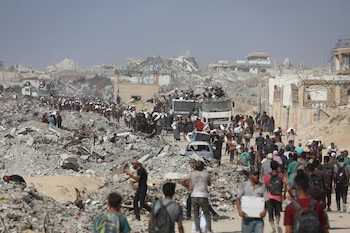
Spain has lent its support to a transformative proposal put forth by French President Emmanuel Macron aimed at establishing a United Nations stabilization mission in the Gaza Strip. This initiative is designed to ensure the security and safeguard the civilians living within the enclave, a region long plagued by conflict and instability.
The Vision behind the UN Stabilization Mission
The proposed UN mission could serve as a crucial instrument in efforts to attain peace in the Palestinian territories and contribute to broader regional stability. Sources close to Europa Press indicate that this initiative might pave the way for advancing a two-state solution. The two-state solution is a widely endorsed framework for resolving the Israeli-Palestinian conflict, envisioning a separate sovereign state for the Palestinians alongside the state of Israel.
During a recent address, Macron urged the mobilization of the UN Security Council to consider this mission, highlighting its potential to support a future Palestinian government. This government would be tasked with vital responsibilities, including the critical disarmament of the Islamic Resistance Movement (Hamas). Since 2007, Hamas has maintained control over the Gaza Strip, complicating peace efforts in the region.
A Shift Towards Peace and Stability
Macron’s vision emphasizes a non-military approach, stating, “We say no to a military operation and yes to an international coalition under the mandate of the UN to fight terrorism, stabilize Gaza and help its population launch a peace and stability government.” This stance illustrates a significant pivot in international diplomacy, focusing on coalition-building rather than military intervention, as the latter has often exacerbated tensions in the region.
The proposal also garners support beyond Spain, with multiple nations recognizing the potential benefit of a UN-led mission in Gaza. This collaborative approach seeks to establish foundations for a peaceful resolution to one of the longest-standing conflicts in modern history.
Challenges Ahead
Despite the optimism surrounding this initiative, considerable challenges lie ahead. The complex political dynamics between Israel and Hamas, as well as tensions among other regional actors, pose obstacles to the implementation of this mission. Questions remain about how exactly the disarmament process would unfold, as Hamas has deeply entrenched support within the Gaza populace.
International support will be critical to address these challenges effectively. The success of the mission relies on a well-coordinated effort among UN member states, particularly those with strong ties to both Israel and the Palestinian territories. Building consensus may prove difficult, given the diverse interests and perspectives at play.
The Bigger Picture
In a broader context, the establishment of a UN stabilization mission could reflect a shift in international attitudes toward the Israeli-Palestinian conflict. The historic reluctance to engage directly in the area’s complexities is now being challenged by renewed diplomatic efforts. The global community recognizes the necessity of an engaged approach to address the region’s multifaceted issues.
Beyond just the immediate concerns of security and stabilization, the mission may also serve as a reinvigorated platform for dialogue between Israel and Palestine. Through patient negotiations and genuine commitment, it is possible to foster a climate where long-term peace can flourish. The eyes of the world will undoubtedly be on Gaza as this proposal unfolds, with hopes that it can begin to mend the fabric of a deeply divided society.