
Controversy Erupts Over ETA Support Banners in Bilbao
The vibrant city of Bilbao, known for its rich culture and festive spirit, is currently embroiled in controversy. The Basque Country has recently witnessed the appearance of banners supporting ETA prisoners during the preparations for the ASTE Nagusia festivities. The collective of victims of terrorism known as Covite has been vocal in its condemnation, calling for action from local authorities to address these provocative displays.
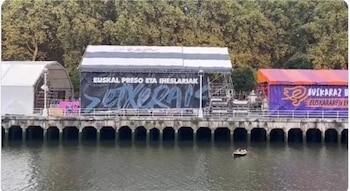
Covite has raised alarm bells regarding the “public exaltation” of ETA, a group whose violent history is still fresh in the memories of many. The organization expressed its deep concern via social media, decrying the emergence of banners displayed in several locations around Bilbao that call for the release of ETA prisoners. These banners have been installed in txosnas, traditional festive booths that are integral to the upcoming Bilbao Grand Week.
Calls for Action Against Institutional Passivity
In a statement, Covite emphasized the need for local authorities, specifically Bilbao’s mayor, Juan Mari Aburto, to intervene. The association stated, “Enough of occupying all the festive public space with messages of request for impunity for ETA terrorists!” They criticized what they perceive as institutional passivity, urging authorities to take a firm stance against the glorification of ETA’s past atrocities.
One particularly concerning incident involved the Txoribarrot comparsa, a local group that erected a sizeable banner advocating for the release of ETA members. Covite has warned that the group’s spokesperson is scheduled to open the Bilbao celebrations and may use their platform to promote further support for the imprisoned ETA militants.
Public Reaction to the Banners
The installation of these banners has ignited a significant backlash from various sectors of the community. Many residents of Bilbao and surrounding areas have expressed their outrage, asserting that such displays trivialize the suffering of the victims of terrorism.
In their need for social and political justice, citizens argue that these banners undermine the principles of democracy and peace. Covite has urged people to reflect, “Would we normalize it if the murderers whose release was demanded were not from ETA?” This rhetorical question highlights the ethical implications of supporting those who engaged in violence and terrorism.
Historical Context of ETA in the Basque Country
To understand the depth of this issue, one must consider the historical context. ETA (Euskadi Ta Askatasuna), translated to “Basque Country and Freedom,” was founded in 1959 and operated as an armed separatist group seeking independence for the Basque Country from Spain. Its actions, which claimed over 800 lives, have left an indelible mark on Spanish society. The reaction to ETA, both from victims’ groups and the general public, has been polarized and passionate.
The aftermath of such violence has created a complex societal dynamic in the Basque region. While some still sympathize with the motives behind ETA’s actions, many others, particularly victims’ families, condemn any form of glorification of the organization. The sentiments expressed by Covite resonate with these victims, who seek not only recognition but also justice.
Concluding Remarks on Societal Implications
In the face of the ongoing controversy, the Bilbao festivities are set to commence amidst heightened tensions. Covite’s strong advocacy against the public display of ETA support reflects broader societal struggles related to memory, justice, and reconciliation in the Basque Country. As the local authorities grapple with how to address these issues, the question remains: how will they balance the celebration of culture with the need for respect towards the victims of terrorism?
The unfolding situation in Bilbao serves as a poignant reminder of the complexities of dealing with a violent past while striving for a peaceful and inclusive future. Engaging in open dialogue about these sensitive issues remains crucial for the Basque society as it continues to navigate the delicate balance between celebration and remembrance.