
Microplastics have infiltrated almost every facet of our lives, reaching from the food we consume to the air we breathe. Found in lettuce , fish , and even in human anatomy, such as male testicles , these tiny plastic particles are pervasive in our environment. Recent studies continue to highlight the alarming extent of microplastics in not only the soil and oceans but also the very air we inhale.
A previous study published in the renowned journal ‘Nature’ provided initial evidence that microplastics are present in our air. A recent investigation, conducted by a French research team and published in ‘Plos One’, sheds more light on the concentration of these particles in the air we breathe—revealing automobiles as significant sources of microplastic pollution. Fortunately, this crisis also presents an opportunity for solutions to mitigate their presence.
The findings of this new study are alarming and straightforward: we are inhaling a far more significant amount of microplastics than previously estimated . Prior research has considerably undervalued the exposure, estimating an adult inhales around 68,000 microplastic particles daily —a staggering figure, especially since it’s one hundred times greater than previous estimates focused on more dangerous particle types.
An Invisible Enemy That Attacks Our Lungs
The problem with previous measurements was their inherent limitations . Conventional detection methods, like infrared spectroscopy, can only identify particles down to 20 micrometers in size. This makes them ineffective against smaller particles, known as PM_10 (less than 10 micrometers)—the very particles capable of penetrating deep into our lungs and evading our body’s natural defense mechanisms.
The new study, led by French researcher Nadiia Yakovenko, employed Raman spectroscopy , a much more precise technique capable of detecting particles down to one micrometer. This advanced method has illuminated just how severe our environmental situation is regarding microplastics.
Using this enhanced technology, the study aimed to identify areas with high concentrations of microplastics. Measurements within residential apartments revealed an average of 528 particles per cubic meter. The troubling part, however, is the *significantly higher levels* detected in vehicles, where the concentration spiked to 2,238 particles per cubic meter .
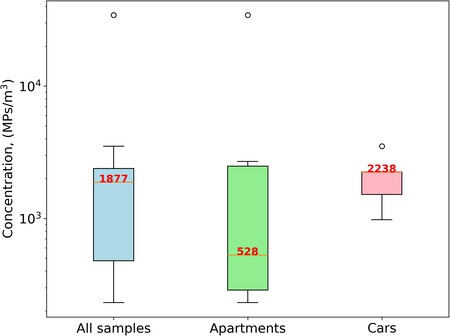
<span>Box chart showing the concentration analyzed with microplastics in cars and apartments. Seven apartments and five cars were analyzed.</span>The fact that these measurements reveal an exposure level four times higher in vehicles than in our homes is alarming. This heightened presence of microplastics in cars can largely be attributed to the extensive use of synthetic materials—such as plastics and upholstery—within a compact space that can remain unventilated for hours. Consequently, when we enter our vehicles, we often don’t ventilate before driving, leading to an environment filled with these hazardous particles.
The New and Alarming Daily Account: 68,000 Particles
This study’s revelations change our understanding of microplastic exposure. By aggregating data from their findings and previous literature, the team recalibrated average exposure rates.
On average, adults encounter a shocking 68,000 microplastics (smaller than 10 microns) each day. These particles pose significant health risks due to their ability to reach the alveoli in our lungs, crossing into the bloodstream through the alveolocapillary barrier formed by pneumocytes and blood capillaries.
In comparison, larger microplastic particles (ranging from 10 to 300 micrometers) typically do not penetrate the alveolocapillary barrier. Instead, they become trapped in the mucous membranes of our upper respiratory tract; while not harmless, they ultimately make their way to our stomachs.
<img alt="Extra virgin olive oil is one of the purest products in the world. And it is also full of microplastics" width="375" height="142" src="https://i.blogs.es/26f27f/plantilla-xtk/375_142.png"/>This constant exposure to microplastics has serious health implications. The authors of the study highlight potential associations between inhaling these particles and lung damage , inflammation , increased oxidative stress , and chronic diseases like COPD .
Moreover, microplastics do not travel alone; they can also ferry heavy and toxic metals that adhere to their surfaces, posing further risks by potentially altering endocrine functions and increasing susceptibility to various diseases.
This research underscores the imperative for further investigation into microplastics, marking it as a complex public health issue that manifests silently yet pervasively. As awareness grows, so does the urgency for mitigation strategies to protect public health and the environment.
Images | Flyd Brock Wegner
In Xataka | More than 50,000 microplastic particles per year: that is what an average citizen ingests according to the first estimate we have