
At the end of the 1960s, commercial aviation was booming. The first civil aircraft with turbofan engines , such as the Douglas DC-8 and Boeing 707 , were redefining the rules of the passenger air transport game. As a result of this scenario, many countries began to implement changes for a future in which flights would multiply.
In Japan, authorities realized that Osaka International Airport , catering to the Kansai region, would not be able to handle the burgeoning air market. Expanding its facilities wasn’t feasible due to stringent regulations established by local residents. This led to the ambitious decision to build a second Kansai airport .
An Airport on an Artificial Island
To avoid constraints such as limited operating schedules and the impossibility of expanding existing infrastructure, plans for a new airport commenced. To alleviate the noise pollution from aircraft, the new airport had to be constructed at least three kilometers from the coast. Consequently, in 1987, the construction officially began, five kilometers into the Osaka Bay.
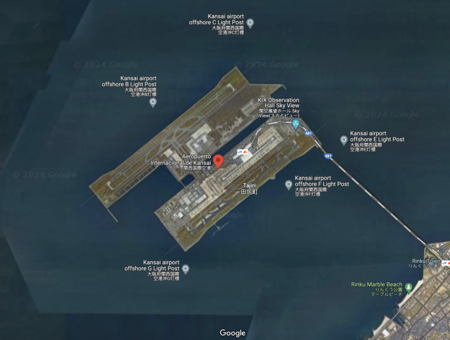
<span>Kansai International Airport</span>To shape the artificial island, numerous excavations were made in the surrounding mountainous areas to gather enough material to fill the site adequately. Every day, from 4 AM until late afternoon, project members effectively transported thousands of cubic meters of rock onto the seabed.
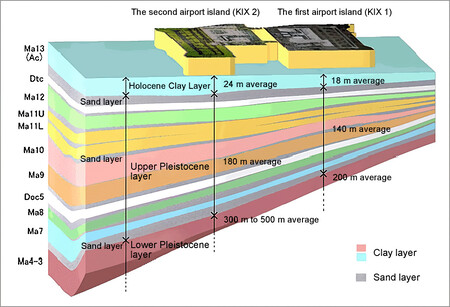
<span>Osaka Bay Marine Bed</span>The oceanic relief in this region comprises a 20-meter thick surface layer known as the Holocene layer, followed by a robust clay and gravel layer that can be several meters thick. These layers tend to yield under pressure, and builders were well aware of this fact.
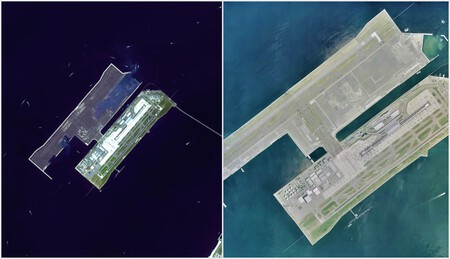
<span>Kansai International Airport: Initial and Secondary Phases</span>The first phase of this project, designed by Italian architect Renzo Piano , kicked off with the construction of the landing floor and a passenger terminal in 1991. To accommodate the island’s sinking, special columns with base metal plates were installed to manage the building’s weight. The airport officially opened its doors in September 1994 .
Just four months later, the airport faced its significant test. On January 17, 1995, the Asian country was struck by the Kobe earthquake , whose epicenter was close to the airport. Remarkably, the structure endured the quake with only slight damage, owing to its sophisticated seismic design.
In 1996, plans for a second runway and passenger terminal received approval, marking the beginning of the second phase, which would take several years to complete. By 2007 , this phase was partially inaugurated, allowing limited service and easing congestion at the airport. The site has since undergone numerous enhancements and maintenance projects.
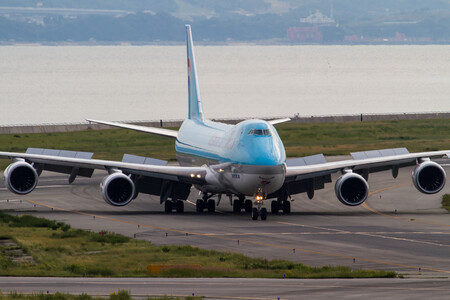
<span>Boeing 747 at Kansai International Airport</span>The engineering prowess behind such a monumental project has garnered worldwide acclaim. In 2001, it was awarded the title of “Millennium Civil Engineering Monument” by the American Society of Civil Engineers. However, it has also faced significant criticism, particularly regarding its exorbitant costs .
By 2008, the construction costs of Kansai International Airport had surpassed $20 billion . A major portion of the expenses was due to the ongoing efforts required to inhibit the island’s sinking. In 1994, the sinking rate was approximately 50 centimeters per year; luckily, this has since decreased to below 10 centimeters .
<img alt="Beware of aircraft wifi: there are scammers that create false networks on flights" width="375" height="142" src="https://i.blogs.es/e73ac8/delta-wifi/375_142.jpeg"/>To tackle the sinking issue, engineers have turned to a sand drainage system . This involves installing sand piles in the clay strata to facilitate the escape of water, thus allowing the clay to solidify. Since the initiation of the project, 900,000 piles have been placed, demonstrating effective results based on current data.
With these advancements and extensive planning, Kansai International Airport continues to play a pivotal role in Japan’s aviation landscape. It stands as a testament to human ingenuity and engineering excellence in overcoming environmental challenges, ensuring safe and efficient travel for millions of passengers annually.
Images | Wikimedia | The Kansai International Airport | Google Maps
*An earlier version of this article was published in August 2024