
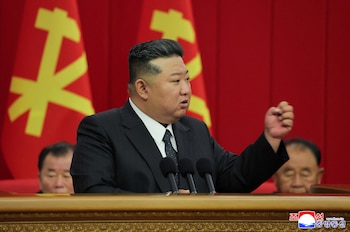
North Korea Issues Stark Warning Amid Upcoming US-South Korea Military Exercises
The North Korean regime has issued a recent threat of military action in response to upcoming joint exercises conducted by Seoul and Washington . Scheduled for next week, these exercises, known as Ulchi Freedom Shield (UFS) , have been described by North Korea as a dangerous provocation. The warning was articulated by No Kwang-chol , North Korea’s Defense Minister, who condemned the maneuvers set to occur from August 18 to 28 .
No Kwang-chol characterized the UFS as a “direct military provocation” and as a “real threat” to regional stability. He stressed that the mission of North Korea’s armed forces is to safeguard the nation’s security interests against what they perceive as hostile actions from the United States and South Korea . “Any crossing of lines by its adversaries will be responded to with the strict exercise of sovereign law for self-defense,” No emphasized in a recent statement.
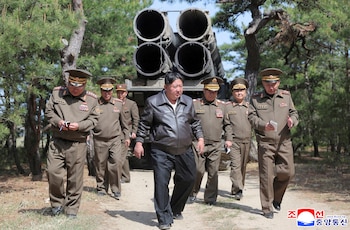
According to No, the UFS is designed to simulate a ” nuclear war scenario ,” which he believes increases unpredictability and instability in the Korean Peninsula. He held both Washington and Seoul responsible for escalating tensions in the region, stating, “Unilateral military threats and the US-South Korea confrontation attempts are the main reason that the situation in the Korean Peninsula is getting worse day by day.”
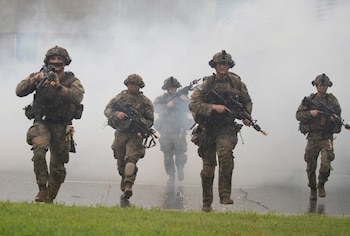
In contrast, South Korean and American authorities maintain that the UFS is strictly defensive. Both nations assert that the primary goal of the exercises is to strengthen response and deterrence capabilities against North Korea’s ballistic missile and nuclear weapons programs.
Interestingly, this year’s exercises have undergone modifications. Of the 40 military maneuvers originally planned, around 20 have been postponed until September. Military sources attribute this decision to an extreme heat wave and damages caused by recent floods. However, some political commentators interpret it as a diplomatic gesture towards Pyongyang aimed at improving bilateral relations.
The South Korean Unification Minister, Chung Dong-Young , indicated in late July that he would propose to President Lee Jae-Myung a re-evaluation of the exercises in accordance with the new administration’s approach to inter-Korean relations. Furthermore, military coordination is expected to be a central topic during the upcoming summit between President Lee and President Donald Trump , which local sources have suggested could occur on August 25 .
Interestingly, the North Korean warning comes at a time when both Koreas have made gestures towards de-escalation. The South Korean government recently reported that the North has begun dismantling speakers used for propaganda broadcasting against the South, just days after Seoul removed its own similar equipment. However, despite these diplomatic overtures, the Kim Jong-un regime has maintained an aggressive stance, with Kim Yo-Jong, the dictator’s sister and a key decision-maker, asserting that South Korea “is still the enemy.”
She further dismissed proposals for denuclearization presented by Seoul and Washington, emphasizing that North Korea has no intention of relinquishing its nuclear arsenal. The rhetoric from Pyongyang seems to underline a dual strategy of asserting military readiness while making superficial gestures of potential diplomatic engagement.
The threat of “countermeasures” exemplifies a recurring strategy that North Korea employs to exert pressure amidst allied military exercises. While the regime has shown signs of openness at times, the official communications remain firmly anchored in a confrontational narrative, signaling their intent to impose military restrictions in the region.
(With EFE information)