
Alessandra Rojo De La Vega Critiques Capital Security’s Narrative: A Coordinated Attack
Summary of the Incident
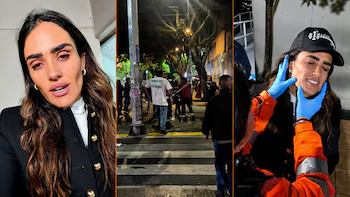
In a shocking escalation of violence, Alessandra Rojo de la Vega, the mayor of Cuauhtémoc, reported that her team was attacked while conducting an official inspection in the Zona Rosa area of Mexico City. Located on Génova Street, the team had just begun their nighttime patrol when they were confronted by a mob armed with shovels, stones, and knives. Rojo de la Vega stated that this was not a mere clash between merchants and government officials, but rather a coordinated attack aimed at public servants fulfilling their official duties.
Detailed Account of the Attack
The mayor described the harrowing moments after their arrival: “We arrived, we didn’t stay even a minute when unfortunately they started to grab us with shovels, stones, knives, blows, screams. They kept cell phones,” she announced during a broadcast on her official channels. This disturbing version starkly contrasts with the official narrative from the Secretariat of Citizen Security, which claimed the incident resulted from a confrontation between mayoral staff and local merchants.
The mayor asserted that around a dozen individuals launched the attack with the intent to obstruct their inspection of street commerce, a long-standing issue that she has publicly denounced.
Attribution of Blame
Rojo de la Vega implicated Diana Sánchez Barrios, a local representative, in orchestrating the violence against her team. According to Rojo de la Vega, people close to Sánchez Barrios have been involved in promoting disruptive behaviors related to street commerce in the Zona Rosa. This leads to broader questions about the political dynamics at play, where local governance and street operations intersect, often in explosive ways.
Aftermath and Official Response
The aftermath of the violent encounter saw an arrest of a 30-year-old individual, while several members of both the mayor’s team and police forces sustained minor injuries. The police reported that four auxiliary officers and two members of the Secretariat of Citizen Security required medical attention.
Despite this, Rojo de la Vega remained critical of the support she received from the capital’s authorities post-incident. She expressed frustration over her unsuccessful attempts to contact senior officials within the Government of Mexico City immediately after the attack.
Moving Forward
In the wake of this alarming event, Rojo de la Vega indicated plans to file formal complaints, stating, “We are now at the Prosecutor’s Office to present the respective complaints.” This move highlights her determination not only to seek justice for her team but also to confront the systemic issues that allow such violence to proliferate.
The attack occurs against the backdrop of intensified operations in the Zona Rosa, as authorities aim to prepare the area for an expected influx of visitors in relation to the upcoming 2026 World Cup. The incident thus brings into sharper focus the challenges of balancing security, commerce, and public safety in a vibrant but contentious locale.
Conclusion
This incident is a stark reminder of the volatile intersections of politics, public safety, and commerce in urban settings like the Zona Rosa. The divergent narratives from Rojo de la Vega and the authorities underscore the complex nature of governance, where claims of coordinated attacks raise concerns about accountability and public sector safety amidst growing tensions.