
Waymo Leads the Charge in the Autonomous Taxi Revolution
The advent of autonomous vehicles has sparked significant interest in the realm of transportation. Among the major players, Waymo , a subsidiary of Alphabet Inc., stands out by providing a pilot program for robotaxi services in multiple cities across the United States. According to a recent analysis by OBI, an app that tracks real-time prices of various taxi services, Waymo’s autonomous rides average $20.43 per journey. This figure surpasses the costs of competitors like Lyft and Uber , which charge approximately $14.44 and $15.58 per ride, respectively. While the disparity in pricing is notable, it hasn’t deterred users; in fact, many are willing to pay a premium for the unique experience of traveling without a driver.
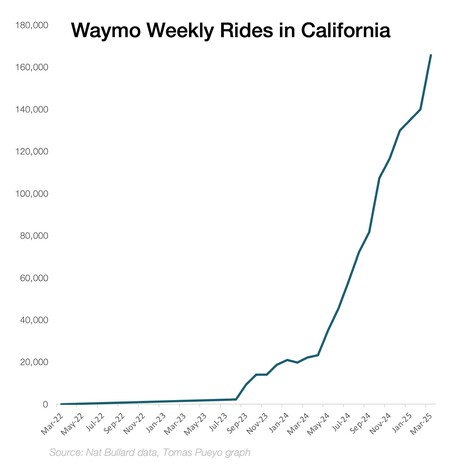
Waymo weekly paths in California. Image: Nat Bullard Data
The Surge in Demand for Robotaxis
Recent data indicates that Waymo’s robotaxi services are gaining traction at an impressive rate. Analysis conducted based on nearly 90,000 rides in San Francisco shows that Waymo can charge between $11 more than its competition during peak hours. Interestingly, this increased price has not negatively impacted demand; Waymo reportedly executes about 250,000 paid trips each week across its initial four cities. This trend suggests that enough consumers place a high value on the autonomous driving experience to justify the additional cost.
Understanding the Pricing Model
One of the noteworthy aspects of Waymo’s operations is its distinct pricing model . Unlike Uber and Lyft, which have developed sophisticated algorithms over years, Waymo utilizes a simpler supply-and-demand approach. The implications of a fixed fleet mean there’s a greater degree of variability in pricing. For instance, short trips under 1.4 kilometers can result in fares reaching around $26 —a markup of 31% to 41% compared to its competitors.
Consumer Sentiment Toward Autonomy
Interestingly, consumer sentiment shows a strong preference toward autonomous rides . Surveys indicate that 70% of passengers who have tried Waymo prefer traveling without a driver. Additionally, nearly 40% expressed willingness to pay the same or even higher fares for this service, while 16% would pay an extra $10 per trip. This demonstrates a growing demand for the “personal bubble” experience provided by self-driving cars, which allows for privacy and comfort during travel.
Safety: The Primary Concern
Despite the excitement surrounding autonomous vehicles, safety remains a pivotal concern for users. Approximately 74% of respondents consider safety the most significant issue regarding robotaxis. Many believe that having some form of remote human oversight during rides is crucial, a practice that is already standard in many sectors within the industry.
Expansion and Market Penetration
Waymo is gearing up for rapid expansion, recently launching services in Atlanta and planning to enter markets such as Miami and Washington, D.C. The company has also begun gathering data in cities like Las Vegas, Dallas, San Antonio, Nashville, and New Orleans . Remarkably, the timeline for entering new markets has shortened significantly—now taking only one to two years from initial mapping efforts to the launch of services.
Across the ocean, Europe is also gearing up for the robotaxi revolution, with initial services expected to roll out in the United Kingdom and Germany by 2026 . Notably, it appears Lyft , in partnership with Baidu , may lead the charge in this segment, indicating a technologically innovative future awaited on both sides of the Atlantic.
As the development and deployment of autonomous vehicles continue to evolve, companies like Waymo are at the forefront of a transportation transformation that promises convenience, efficiency, and a new era of travel.