

The United States is currently navigating the complexities of trade tariffs under the administration of former President Donald Trump. Despite the challenges posed by a fluctuating dollar, the nation is witnessing some positive outcomes from its tariffs aimed at various countries. One of Trump’s primary objectives has been to implement higher tariffs, particularly on technological imports, which he claims to have successfully achieved since his initial campaign for economic liberation.
What Happened
Recently, Donald Trump unveiled a new tariff plan focused specifically on semiconductor imports . He proposed a 100% tariff on semiconductor chips for companies that do not commit to manufacturing within the United States. His stance is direct:
“We are going to apply a very high tax to chips and semiconductors. But the good news for companies such as Apple is that if they are manufacturing in the United States, or have the commitment to do so, without any doubt, there will be no charge.”
Apple Breathes a Sigh of Relief
The timing of Trump’s tariff announcement coincided with a meeting he held with Apple CEO Tim Cook in the Oval Office. During this meeting, Cook presented the company’s commitment to invest an additional $100 billion in the United States, bringing its total planned national investment to $500 billion over four years. This investment aims to generate approximately 450,000 jobs and establish manufacturing operations in 79 factories across the country, directly employing 20,000 people .
Apple’s significant investment is primarily influenced by the prospect of stability in its manufacturing operations. Trump’s statement explicitly addressed Apple, granting them a reprieve from tariffs if they follow through on their commitment to produce in the U.S.
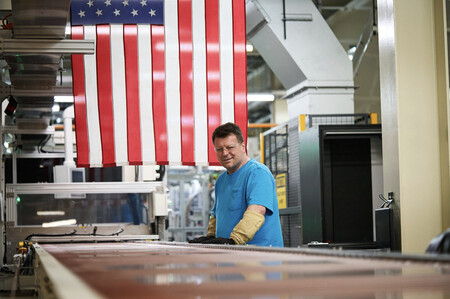
Apple will manufacture all its glass with Corning in the United States.
While it’s evident that the iPhone’s price point remains substantial, with the iPhone 13 Pro starting at $999 , earlier tariff projections predicted that a model like the iPhone Pro Max with 1 TB of storage could jump from $1,599 to $2,300 . This potential price increase poses a significant challenge for Apple, complicating the business landscape.
Tim Cook has openly addressed the challenges of manufacturing in the U.S., noting that producing a complete iPhone domestically is still a distant goal. However, Apple recently announced that the glass for all its iPhones will now be sourced from U.S. facilities. This move is part of their broader strategy that also includes sourcing rare earth magnets from U.S. suppliers. To further solidify their commitment to the administration, Apple gifted Trump with a 24-carat gold statue made of crystal —a symbolic gesture portraying their dedication to adhering to U.S. manufacturing standards.
The rumors surrounding the upcoming iPhone 17 Pro suggest a price hike of around $50 , an increase that could appear minimal compared to the total investment needed— $600 billion . For context, this amount represents nearly two years of Apple’s total income.
Eye on Compliance
The tariff landscape remains fraught with uncertainties; the real test lies in whether companies and countries will fulfill their promises. For example, Europe has pledged to purchase $600 billion worth of energy from the United States, but both the financial capacity of Europe and the energy supply from the U.S. remain in question.
Trump has taken a firm stance against companies that do not comply with their commitments, warning that if manufacturers fail to deliver on their promises, they will face additional tariffs retroactively enforced.
TSMC Makes Moves
Taiwan Semiconductor Manufacturing Company (TSMC) , a leading manufacturer of advanced chips utilized by major tech giants like Apple and Nvidia, is highly sensitive to these tariffs. In a proactive move, TSMC announced a $100 billion investment to establish five new plants in the U.S., alongside the existing facilities in Arizona . If Trump’s assurances about tariff exemptions for domestic manufacturing hold true, TSMC stands to benefit significantly.
Tariffs Expanding Beyond Technology
In a broader context, Trump recently announced additional tariffs aimed at India , imposing a 25% tariff in retaliation for the country’s importation of Russian oil and gas. This action falls under what the administration terms secondary sanctions , indicating a significant expansion in the scope of U.S. tariffs.
All in all, the landscape of trade tariffs under Trump’s administration is complex and evolving. Companies like Apple are making significant investments to stay ahead of the curve, while the effectiveness of these tariffs in reshaping the economic landscape remains to be seen.