
Palantir Technologies has recently achieved a remarkable milestone by surpassing established giants such as Samsung , Costco , and Coca-Cola . With a staggering market capitalization reaching $411 billion , the data analytics company founded by Peter Thiel in 2003 is capturing the attention of investors and analysts alike.
Why is it important? Achieving a valuation of $411 billion despite generating $1 billion in quarterly revenue indicates that Palantir’s perceived value in the market transcends traditional financial metrics. This phenomenon showcases the growing impact of “AI washing,” where investors prioritize companies based on their engagement with cutting-edge technologies, particularly artificial intelligence .
The facts. Palantir reported an impressive 48% increase in revenue , surpassing the $1 billion mark for the first time. Their commercial contracts in the United States experienced an astounding 93% growth , while government contracts rose by 53% . Overall, the company’s profit surged by 144% , reaching $327 million .
In figures. Palantir’s Price to Earnings Ratio (P/E) has reached an astonishing 596 , significantly higher than industry peers like Nvidia at 57 , and almost twenty times higher than Apple at 31 . To justify its current valuation, Palantir would need to sustain an annual growth rate of 55% for the next four years, which, even in optimistic scenarios, would forecast their 2029 income at 25 times current values.
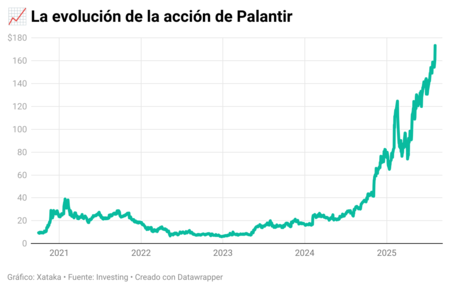
The context. Wall Street currently thrives on a speculative bubble, fueled by companies leveraging the allure of artificial intelligence . Palantir, historically tethered to defense contracts, has repositioned itself to highlight its capabilities in deploying AI solutions in a real-world context. Under CEO Alex Karp , the company has positioned AI as a transformative force for businesses.
- In a bold statement, Karp has exclaimed that “the great language models simply do not work without Palantir.”
Yes, but. Despite the current enthusiasm, significant issues loom in the background. The company’s future sales are projected at 80 times its current metrics, a valuation that exceeds historical norms seen in the S&P 500.
Deutsche Bank, which maintains a sales recommendation on the stock, acknowledged that “something special is happening,” yet still expressed concerns over Palantir’s lofty valuations. This financial institution has recently adjusted its stance to avoid appearing entirely disconnected from market realities.
Between the lines. In a recent earnings conference, Karp utilized the platform to critique elite universities and emphasized that AI technology could equip non-college-educated workers with ” superpowers .” This populist rhetoric plays well in the current political climate but fails to rationalize an evaluation that designates Palantir as one of the most overpriced companies in the world’s premier stock market index.
The big question? Can a company generating $4 billion annually, akin to Johnson & Johnson , a multinational boasting $85 billion in revenue, hold the same valuation? Or can it be comparable to Coca-Cola , whose income is tenfold that of Palantir?
The markets appear to affirm a resounding “yes,” reflecting a belief that AI can radically reshape the economy. Palantir has undeniably established itself as a key symbol of this burgeoning belief, marking its presence at the forefront of an evolving technological landscape.
While optimism remains high, it raises critical questions regarding sustainability and the inevitable fallout should the speculative bubble burst. With stakes this high, the journey ahead for Palantir Technologies promises to be as exhilarating as it is uncertain.