
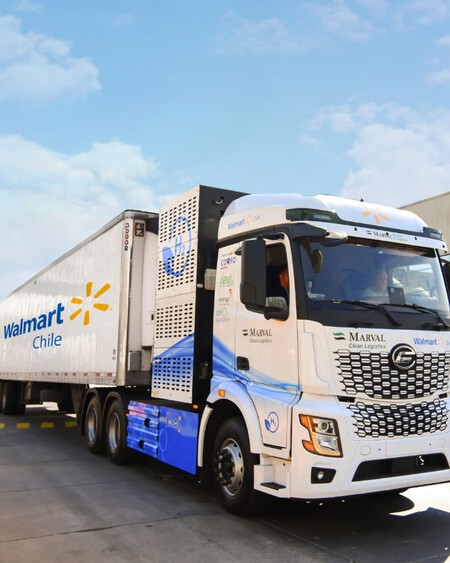
What if the future of heavy logistics in Latin America had already begun, catalyzed by a single truck? In a region where the transport of goods largely relies on diesel engines, Walmart has achieved homologation of the first tonnage moved by green hydrogen. This milestone occurs in Chile , where a vehicle can reportedly exceed 700 km of operation without emitting CO2 . While still in the testing phase, it marks the initiation of a transformative journey.
Chile has been chosen not only to test this innovative truck but has also become a hub for public-private collaboration aimed at pioneering heavy transport devoid of emissions. Walmart’s participation in the *Hidrohaul* program, promoted by the Corporation for Production Promotion (Corfo), involves an initial investment of $6.15 million with a clear objective: to assess the scalability of this cutting-edge technology.
An Experiment That Can Mark a Before and After
This initiative aligns seamlessly with Walmart’s global mission to decarbonize all its logistics operations by 2040. For Chile, this serves as a pilot program that could lay the groundwork for a National Transportation Network powered by green hydrogen.
Manufactured by the Chinese company Feichi Technology, the truck is equipped with a hydrogen fuel battery that generates the electricity necessary for its engine. Its capacity allows it to transport up to 49 tons , with the ability to travel up to 750 km on a full load using 75 kg of hydrogen .
Interestingly, this truck qualifies as an electric vehicle; however, its energy generation is distinct. Instead of charging a battery through the electrical grid, it utilizes a hydrogen fuel battery . This system combines hydrogen with oxygen to produce electricity, water, and heat. The generated electricity then drives the truck’s electric motor.
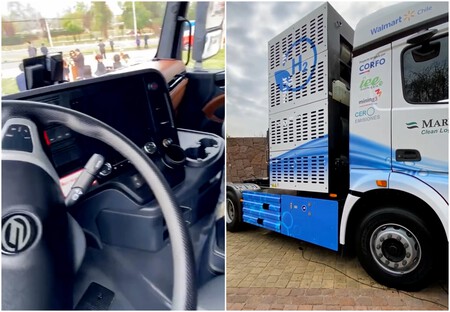
</div>With no combustion involved, the truck emits only water vapor, thus ushering in a different means to achieve zero-emission heavy transport.
The initiative commences in Quilicura, located in the metropolitan area of Santiago. In 2023, Walmart Chile launched the first green hydrogen industrial plant in collaboration with Engie. This facility houses a 0.6 MW electrolyzer , powered by renewable solar and wind energy, which separates water molecules to generate hydrogen.
The plant not only fuels the new truck but also supports a fleet of hydrogen-powered wheelbarrows already in operation at the logistics center.
The Refueling: The Great Challenge for Expansion
The truck’s range permits operations within Chile’s central region , yet it falls short for longer journeys. There remains an absence of a public refueling network for hydrogen-powered trucks.
</div>Facing this challenge is not solely technical; it demands logistical and economic considerations: how many trucks are necessary to justify the installation of a hydrogen refueling station? Where should these stations be located to effectively cover critical transport routes without wasting resources? Similar scenarios in California foresee multiple high-volume stations catering to thousands of trucks by the early next decade. Chile must develop its own strategy to address these questions.

At the core of critical discussions is whether investing in hydrogen technology is worthwhile. It boasts notable advantages for long-haul trucks: extended range, quick refueling, zero emissions, and a lower weight impact compared to purely electric alternatives. However, it remains an expensive technology and encounters significant breathing space due to limited refueling infrastructure and reduced energy efficiency compared to other methods. It’s not a panacea, but rather a useful tool that can fulfill a specific role—exactly what Chile is striving to determine: does hydrogen have a place in its responsive logistics framework?
Images | Walmart Chile
In Xataka | Welcome to the silent collapse of energy: In the US, AI is beginning to drain the country’s electricity