
The Complexities of U.S. Foreign Policy in the Middle East
In recent developments, the United States Department of State distanced itself from the contentious remarks made by Mike Johnson , the President of the House of Representatives. Johnson declared from an Israeli settlement in the West Bank that this territory rightfully belongs to the “Jewish people by law.” Such statements pose a challenge to the established U.S. policy regarding the Israel-Palestine conflict.
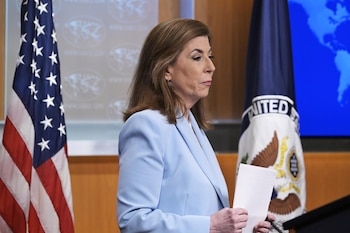
The State Department spokeswoman, Tammy Bruce , emphasized that Johnson’s statements do not represent an official policy of the U.S. government. “Of course, that’s not … if there was a policy about it, I would tell you,” she remarked, further clarifying, “I will not speak in his name or characterize his words in any way, but it is clear that this is his opinion.” This clear separation from Johnson’s comments highlights a broader issue within U.S. foreign policy: the divergences of opinion among key political figures and the administration’s stance on sensitive geopolitical issues.
The Significance of Johnson’s Remarks
Johnson’s assertion came during a visit to Ariel , the largest Israeli settlement in the West Bank. His comments have drawn attention, both domestically and internationally, primarily because they touch on a highly sensitive topic within the ongoing Israeli-Palestinian conflict. The idea that the West Bank belongs to the Jewish people intertwines deeply with historical, religious, and political narratives, and Johnson’s remarks have reignited debates surrounding land ownership and rights in the region.
Bruce faced further questions about whether Johnson’s views align with those of the White House . She refrained from directly addressing this, maintaining that official U.S. policy statements about any situation, particularly in the Middle East, would come from higher authorities like the Secretary of State and the President.
U.S. Foreign Policy Framework
In recent years, U.S. foreign policy towards Israel and Palestine has navigated a complex landscape of diplomatic relations, interests, and milestones. The two-state solution remains the centerpiece of many discussions, aimed at providing a framework for resolving the longstanding conflict. However, comments like those made by Johnson threaten to undermine this delicate balance by appearing to legitimize unilateral claims over disputed territories.
The U.S. has historically been a significant player in the peace process, yet there are concerns that internal political disputes, like the one represented by Johnson’s comments, can lead to confusion about the U.S. position. It illustrates the struggle for unity among American lawmakers regarding foreign policy, particularly in relation to Israel—a topic that often divides Congress along partisan lines.
Impacts of Settlements on Diplomacy
Settlements in the West Bank present a significant obstacle to peace negotiations. They are viewed by many in the international community as illegal under international law and a barrier to achieving lasting peace between Israelis and Palestinians. Johnson’s statements may embolden further settlement growth, which could affect future negotiations and the peace process.
President Biden has advocated for a careful approach that avoids exacerbating tensions. However, the influence of vocal lawmakers like Johnson complicates these efforts. When influential political figures voice strong opinions, it can shift public perception and policy discussions, sometimes leading to actions that are contrary to diplomatic goals.
Ultimately, this situation demonstrates the ongoing complexity of U.S. foreign policy in the Middle East—an area characterized by intricate histories and contested narratives. As public and political opinions continue to evolve, the challenge remains for the U.S. government to maintain a coherent and balanced approach to one of the world’s most enduring conflicts.
The ongoing debate surrounding U.S. foreign policy, particularly as it pertains to Israel and Palestine, emphasizes the need for clear communication among political leaders and the administration. As these complexities unfold, the impact on diplomatic relations and the prospects for peace remain inextricably linked to the words and actions of key figures in American politics.