
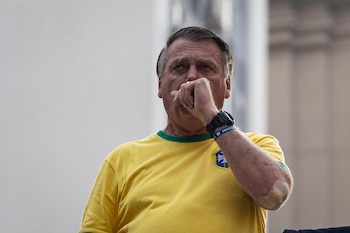
The Supreme Court of Brazil has made a significant move by placing former President Jair Bolsonaro under house arrest due to accusations linked to a coup plot. The decision was announced on a recent Monday, highlighting the ongoing turmoil within Brazilian politics.
Background of the Case
In a decisive turn of events, Judge Alexandre de Moraes of the Supreme Court stated, “Given the repeated breach of the previously imposed precautionary measures, I order the house arrest of Jair Messias Bolsonaro.” This reflects not just the gravity of the situation but also the court’s frustration with Bolsonaro’s non-compliance.
Reports indicate that Bolsonaro is under scrutiny for his alleged involvement in financing a coup plot from the United States. There are claims that substantial funds, estimated to be around two million reais (approximately 300,000 euros), were allocated for a campaign led by his son Eduardo Bolsonaro since March. This campaign purportedly aimed at encouraging the U.S. government to impose sanctions on Brazilian authorities, including judges from the Supreme Court whose visas the U.S. has revoked.
Details of the Allegations
Investigative authorities have outlined grave accusations against Bolsonaro and several other individuals, labeling them as part of a “central nucleus” of a coup conspiracy. Specifically, they are being charged with criminal association, an attempt to undermine the rule of law, and coup d’état, based on events that transpired during protests on January 8, 2023.
These protests were characterized by attempts to disrupt institutional operations—an act that, if proven, could carry severe penalties. The Prosecutor’s Office has already expressed a desire for Bolsonaro to be convicted, highlighting the potential for prison sentences of up to 40 years, in addition to an indefinite disqualification from holding public office.
Global Repercussions
The ramifications of Bolsonaro’s actions stretch beyond Brazil’s borders. By allegedly attempting to secure international sanctions against Brazilian officials, he may have jeopardized Brazil’s diplomatic relations, particularly with a nation as powerful as the United States. President Donald Trump had previously displayed a keen interest in Bolsonaro’s legal troubles, further complicating the situation.
Should these allegations hold ground, it might reshape Brazil’s political landscape significantly and could even affect its international standing. Political analysts are closely monitoring the developments, as they can set precedents for future governance and accountability within the country.
The Political Landscape in Brazil
Bolsonaro’s presidency (2019-2023) was marked by controversial policies , divisive rhetoric, and a significant challenge in addressing Brazil’s pressing issues, including rising inequality and environmental degradation. His tenure has polarized public opinion, making this judicial process a point of contention amongst his supporters and detractors alike.
The house arrest serves as a crucial moment not only for Bolsonaro but for Brazil’s entire political framework. It calls into question the very essence of democratic principles and the extent to which political figures can be held accountable for their actions.
Implications for Governance
In an era where public trust in politicians is dwindling, the Supreme Court’s actions may restore some faith in Brazil’s judiciary as an institution capable of maintaining checks and balances. As the situation continues to unfold, citizens will undoubtedly keep a keen eye on how these legal proceedings progress and what it might mean for Brazil’s future governance.
The political turmoil surrounding Jair Bolsonaro speaks volumes about the current state of Brazilian democracy. As the nation grapples with these profound challenges, it faces a pivotal moment in history that may redefine its political identity. The ongoing investigation and legal outcomes will not only shape Bolsonaro’s legacy but will also influence the fabric of Brazilian governance moving forward.